Skip to content

Posts tagged ‘books’

Review: Little Book of Liverpool, and Bloody British History: Liverpool

The two books here, both published by the History Press, have been written by authors with previous well-known Liverpool books under their belts. Alexander Tulloch wrote the general history The Story of Liverpool, while Ken Pye is best known for his coffee-table book Discover Liverpool. Read more

The British Side of Liverpool Cosmopolitanism

Photograph of the Welsh Presbyterian Church on Princes Road, Toxteth, Liverpool

Welsh Presbyterian Church on Princes Road, Toxteth (Old Liverpool Church, by Exacta2a)

Amongst the many things Liverpool is famous for, its long-held cosmopolitan nature is probably one of those which Scousers are less annoyed at being reminded of.

Liverpool’s long history of being a world port, along with its notorious role in the African slave trade have perhaps more than any other factors stamped their effects on the city’s image as a – cliche alert – ‘melting pot’.

But what I’ve only recently come to appreciate is just how influential incomers from our own isles have contributed to the landscape and character – the atmosphere – of Liverpool. As a landscape archaeologist this has usually been of little interest to me (except where it affects road names and ‘territories’. But since reading Our Liverpool, and now finally making headway with the giant Liverpool 800 book I’ve come to realise just what ‘Liverpool Cosmopolitanism’ can really mean.

I also feel a greater understanding of the way people from all over Britain (the ‘Celtic’ states) come together to make Liverpool the individualistic town it is.

The British in Liverpool

I can’t judge as an expert, but Liverpool 800 draws the lines between the characters of Irish, Scottish and Welsh immigrants fairly clearly

The Liverpool-Irish

The Irish are some of the most famous of Liverpool’s incomers. Both sides of my family (the Crilleys and the Greaneys) came over from Ireland in the 19th Century, and I can guess that a large proportion of Liverpudlians reading this could trace a similar lineage of their own.

A huge number of Irish migrants came over fleeing the potato famine in the middle of the 19th Century. Their numbers rose quickly and they were often stuffed into tiny and unclean court houses. They arrived poor, lived in squalid conditions and had a reputation for harbouring diseases in their communities, and conflicts often arose out of this with their neighbours (see below).

On the other side of the coin, yet still probably due to their great numbers, the Irish community contributed more than other groups to politics. The sectarian troubles of their homeland were brought across the Irish Sea, but in addition to the differences between Protestant and Catholics the Irish community took part in electoral politics. Irish Catholic clergy were elected to School Boards. Pub landlords like Hugh McAnulty and Jack Langan lent their premises to meetings of various activist groups. Austin Harford, a successful cloth merchant, led the Irish Party from 1903 to 1923, and became the first Catholic mayor in 1943.

As Liverpool 800 has it, ‘Liverpool-Irish’ was a distinct ‘hypenated identity’. Even as some sought to distance themselves from their roots as a way to “effect the quickest way out of the Liverpool ‘ghetto’”, it seems that as a distinct group the Irish were very active in all parts of Liverpool life (William Brown, funder of the Museum which sits on the road named after him, was an Ulsterman).

Cymry Lerpwl

The Welsh, in contrast to the Irish, appear at first to have kept themselves to themselves (or “looked after their own”, Liverpool 800, p.345). Having not come as far as the Scottish and Irish, many only stayed as long as it took to make their fortune and move back home. Others came seasonally to work, travelling along the coastal trade routes of north Wales.

This insularity was exaggerated by the language barrier that the Irish never found trouble overcoming. The Welsh were known for their building skills, and the various groups of ‘Welsh Streets’ of ‘Welsh Houses’ became a hallmark. In addition Liverpool became dotted with the Welsh chapels which can still be seen across the city today. In a way these were enclaves which may have helped isolate the Welsh from wider involvement in, for example, politics.

However, in later years there were movements to end this isolation. One of the problems was seen to be the lack of education which Welsh migrants had. Many were labourers and it was felt that this lack of further skills prevented the Welsh from becoming something more than admired builders and architects.

Even as the Eisteddfod and St David’s Day celebrations took place on Merseyside there were encouragements to “Amalgamate … with Anglo-Saxons – in other words, the English”. Though “they loved their language [and] they loved their country” they also “loved their Queen”.

However, perhaps due to their lower numbers, although they took part in electoral politics they never left the mark in the way the Liverpool-Irish did.

Liverpool Caledonians

As Belchem and MacRaild admit in their chapter ‘Cosmopolitan Liverpool’, the Scots are relatively unstudied in their roles within Liverpool history. But the journal Porcupine suggested in 1877 that “had it not been for the enterprise of the Scotchmen, Liverpool would not have emerged from its early obscurity”.

What surprised me therefore was that it was individual Scottish men, rather than communities, which seem to have made their mark on Liverpool. Sir John Gladstone, father of a future Prime Minister, moved to the city from Leith. He was a commercial man, as were many of his fellow Scots, including Samuel Smith, the ‘Cotton King of Liverpool’.

The professional contribution of Scotland was not confined to commerce. Dr. Duncan, the first Medical Officer for Health, was just one of the leading lights in medicine of Scottish origin.

The skilled Scots tended to cluster further from the docks than their Irish contemporaries, right on the outskirts of the north end of the city. This, Belchem and MacRaild tell us, was partly due to no love being lost between the Scottish and Irish. Indeed the reputation of the Irish for living in filthy and overcrowded courts was not confined to the Scots, though perhaps the records left us by those such as Dr Duncan mean we are left in no doubt as to the Scottish opinion.

British Liverpool

As I’ve said, as someone more usually interested in the bricks and mortar of the city, and the landscapes of roads and fields, the topic of people has always played second fiddle to the built environment. But this chapter in Liverpool 800 has give me a glimpse into the roles into which the ‘Celtic’ nations fitted in Victorian Liverpool.

Having said that, one of the things which struck me were the well-defined lines between what the Irish immigrant could expect to find when he arrived from Belfast compared to the life of the Welsh builder or the Scottish shipwright.

Was the truth of the matter so clear cut? I’m sure it wan’t, but what impressions do you get of the Irish, Scots and Welsh in historic Liverpool? Was it the numerous and politicised Irish? The skilled or highly educated middle and upper class Scotsman? And the quiet, insular Welsh communities with their occasional outbursts of Eisteddfod extravaganzas?

Or none of these things?

Review of Our Liverpool, by J.P. Dudgeon

Cover of the book Our Liverpool, by J.P. Dudgeon

Our Liverpool, by J.P. Dudgeon

Our Liverpool (subtitled Memories of Life in Disappearing Britain) is part of the Disappearing Britain series from Headline Publishing, and the third oral history volume from author J.P. Dudgeon, whose previous include Our Glasgow and Our East End.

When I first picked up this book I wondered how an outsider would portray the city, and how they’d get into the community. I also wondered whether it would have much to say about the landscape of Liverpool, as that’s what this website is all about. I have to say I was very pleasantly surprised. Although it takes some time to settle down, Dudgeon pulls together interviews new and old (as well as some written sources) to paint the landscapes of Liverpool in vivid strokes. This book has added a new layer to what I think of as the landscape of Liverpool.

Memories, Maps and personal histories

The main body of the book consists of interviews with local residents. Some were conducted by the author for this book while others were found in the archives of Liverpool Record Office. The book opens with a Beatles anecdote (perhaps inevitably) from a chap in a town centre pub. After that it takes in stories from dozens of other Scousers, including professional historians like Eric Lynch and Mike Royden. These experts give both historical detail as well as personal accounts, and add a variety and sheen that might otherwise be missing from an ordinary oral history.

The first thing that surprised me was just how far back this history goes. There’s a sketch map of Liverpool in the 13th Century, and discussion surrounds the older important places such as Toxteth and West Derby, as well as the Vikings and the Norman invasion. These early book chapters take the reader through to the end of the nineteenth century, the call of the sea (a recurrent theme) and the horrors of the slave trade.

Unfortunately, I found a couple of odd bits of history in these pages. This is George Lund’s take on the origins of the name Toxteth:

“The first settler was a Viking man called Tokey, and “teth” means “settlement”, or “landing place”. Well, they couldn’t call it Tokeyteth, so they substituted an “x” and called it Toxteth.”

I’m not sure who ‘they’ are, but their scientific approach to name creation seems a little out of place (perhaps I’ll let him off as this is a quote in an oral history after all!). Another odd one is the Toxteth riots, briefly introduced on p8:

“Toxteth, at its zenith, marked out Liverpool-born black people as being at the forefront of change on a world scale, a fact that so troubled the then recklessly conservative Establishment that they brought the whole scene to a violent close, triggering the infamous riots of 1981″

This summary of the causes of these riots seem to have lost something in the editing process. The origins of the riots are discussed in more detail later on, but finding this near the beginning of the book worried me as to the extent of Dudgeon’s historical knowledge.

The first few chapters suffer a bit from this over-keenness to buy into the spirit of the town, and the odd skipping around topics (Williamson’s Tunnels are tossed in just after slavery, perhaps just to maintain chronological order), but once the book gets going, it settles into a pacey, emotional, passionate and compelling story of the city told through the eyes of its inhabitants.

Liverpool through the ages

Our Liverpool is a people’s history of the city. While not consisting of landmarks (as such) or maps, what comes out is exactly what historians of pre-writing periods have been trying for years to achieve: a psychological landscape of the region.

What are the landmarks, boundaries and territories in people’s minds? These are of huge importance to local people (as the book successfully shows); they are shared and they help bind and separate communities. Where prehistorians are completely lacking in this type evidence, Our Liverpool ensures that we will never wonder what it felt like to live in Liverpool up to the 21st Century.

For me the book depicts ‘landscapes’ like Scottie Road, the Seamans’ Home, even the Pier Head and the sea herself as stages on which life takes place. The sea especially takes a starring role: it pulls young lads to the navy, it bounds the city on one side, it brings in people and steals them away and it is the lifeblood of trade.

The chapters covering the 1930s, 40s and 50s are coloured with some nostalgia. The 1940s especially seem to have been a golden age in Liverpool. Maybe this is because certain interviewees have particularly fond (childhood) memories of this time, or perhaps because this was just before communities were ripped apart and shipped to the four corners of Merseyside in the following decades. As you can see, location (landscape) is everything to society in tough times.

Chapter 11, ‘Sixties Transformation’, is the longest chapter, as the decade was perhaps the one which most shaped the people of Liverpool for years afterwards. Whereas earlier chapters show the importance of large areas, suddenly ‘territories’ are the clubs you go to, the pubs you drink in and the community centres you frequent. Race and religion become increasingly divisive (and inclusive) as area-based community solidarity was broken up by the Council wrecking ball.

This theme carries through to the end of the book. Scotland Road is turned into a sterile dual carriageway devoid of housing. People move away and where you live seems to become less important as family ties to an area are broken. It’s implied that this is a major contribution to the breakdown of society, and I for one wouldn’t argue against it being a factor.

It may be through rose-tinted spectacles, but people paint a picture of a lost time where violence was honest, short lived and bare-fisted, and no grudges were held. These days, it seems, knives, guns and drugs put a new edge on gangland rivalries which the community cannot absorb, as there is no community left.

By this point in the book Dudgeon seems to know his subjects much more closely. He becomes a passionate neo-Scouser giving voice to the people he found in Liverpool, a voice often lost or ignored. Perhaps his initial outsider status helped him gain the trust of the people he spoke to.

Conclusion

So is this a book for the local historian, or a nostalgia-fest for the armchair sociologist? I was a bit sceptical at the start, and was worried by the strange historical details in early chapters. But having read through the trials and tribulations of these Liverpudlians, and seen how the roads, streets and lanes of their city create the psychological landscapes which shape every aspect of their lives, it’s like a new layer has been added to the maps found in the archives. The territories walked by these people are just as real and clear cut as the boundaries on a ward map, as enabling and constricting a feature as was the Pool itself which lent life to the young town.

It’s a book which will be of interest to those who enjoyed the Lost Tribes of Everton, and is a document which will be of invaluable help to present and future historians wanting to know how people used the landscape, how they crossed it during their daily movements, and how it shaped the people they are.

New book on Liverpool’s buildings, and how cities make us

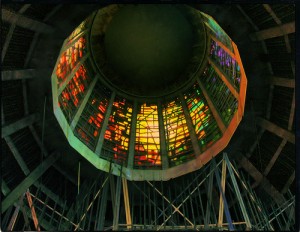
Looking up at the interior of the Roman Catholic Cathedral, Liverpool

Liverpool Metropolitan RC Cathedral, by Jonathan Gill via Flickr

A new book is released this month by Stephen Bayley, and published by RIBA.

Liverpool: Shaping the City is a large and colourful exploration of the city’s built history. It includes development, old and new and brings in photographs from the early 20th Century when some of Merseyside’s most iconic buildings were being constructed.

We learn in the Foreword by RIBA’s president Ruth Reed that Liverpool can lay claim to three world firsts in architecture: the first building to use skyscraper technology (Oriel Chambers in Water Street), the first wet dock (no prizes for guessing) and the first hydraulic cargo-handling system.

Perhaps I’ll come back to a full review of this book once I’ve read it (it only arrived this morning!), but suffice to say it looks to include good coverage of how Liverpool has developed as a city, and how it does and will continue to change as the years progress.

Meanwhile, you can read a column in the Times by Stephen Bayley, How Liverpool returned from the dead which introduces some ideas from the book. His main point is that you can ‘design your way out of a depression’ by building cities which bring joy to people. From a personal point of view, I whole-heartedly agree (though my cynicism would reword it as ‘design yourself towards the end of a depression), which is why I – and others – get so animated when an ugly construction is plonked down in a beloved vista.

My favourite quote from the article, and one which almost single-handedly justifies this blog and my interests in Liverpool’s buildings, is “We make our environments and then our environments make us”. He suggests putting it on a T-shirt, and I just might.

Local History on the Ground and The English Semi-detached House – Book reviews

I’d like to review two books recently added to the NMR’s Library, which both have use for the local historian, and yet which are very different approaches to explaining their field. The first is Local History on the Ground by Tom Welsh (The History Press, 2009). I picked up this book hoping to recommend a good starting point for learning how to approach local history research. Instead, it’s a much more informative lesson on how not to approach the study of your local area.

Local History on the Ground, by Tom Welsh

Local History on the Ground, by Tom Welsh

Tom Welsh is a senior lecturer in Geography at the University of Nottingham. This shows in his clear writing style, good structure and approachable tone. He also has a number of good tips to help the amateur landscape historian gain access to places often difficult to see. However, the man has a bee in his bonnet, and over the course of the book this bee gets in the way of his point, and it becomes increasingly obvious over time just what the problem is.

The clues come early on with Welsh’s keenness to separate ‘archaeology’ from ‘local history’. To Welsh, archaeology is sytematic, scientific and prescriptive to the point of boredom. Local history is emotional, following-your-nose and instinctive, to the point of passion. Archaeologists get bogged down in the minutiae of sites and objects, and ignore the wider landscape, and are obsessed with the “scare story” that is stratigraphy. Another issue is their insistence of walking in straight lines over the ground (“systematic survey”) which is done to remove any biases and ensure objectivity when identifying features (“Why does ecology not get bogged down with this?”). He’s clearly unaware that the specific technique of field walking has the aim of identifying finds on recently-ploughed land, and has little concern with features. Systematic survey is something different altogether.

“There is a lot of mumbo-jumbo in archaeology” – Welsh, 2009.

After distancing himself from archaeology (the study of the past through interpretation of material remains and environmental data, including architecture, artifacts, features, biofacts, and landscapes (Wikipedia)) he soon begins to reveal just how much vitriol he has for the profession. Archaeologists are defensive of their data, and of the historic environment in general (“a lot of heritage goes unnoticed as a result”). Amateurs are a nuisance to them, and they never (ever) let an amateur contribute to, say, the Historic Environment Record. By Page 91 it has been revealed that archaeologists seem to have snubbed Welsh’s own attempted contributions over the last 30 years. In one example of his work, he suggests that a hilltop site at Auchingoul is not a quarry, as the archaeologists suggest, but a Roman camp (an interpretation dismissed by OGS Crawford 60 years ago). He has done the fieldwork to prove it, and his neat little sketch shows a series of ponds, more ponds, a double pond, and an ‘access to pond’ track. Not sure where the Romans where meant to actually live, or why the famously standardised Roman camp template was abandoned. Perhaps because this site was 150 miles from the edge of the Roman empire.

So having never heard of landscape archaeology, or possessing any understanding of archaeological stratigraphy (he should realise it’s not just between sites, but within sites, and within features!) or fieldwalking, or geoarchaeology (archaeologists ignore geology, apparently), what has Welsh brought to the table in terms of technique? He clearly realises that landscape is the key to interpreting sites, but it seems that houses, tarmac and recent buildings get in the way of this. Despite his great contributions to the field of landscape history, W.G. Hoskins also made the mistake of seeing modern development as a muddying of the archaeological record, rather than an intrinsic part of it. And perhaps some archaeology is too concerned with classification (it certainly was when the majority of Welsh’s sources were written, in the 60s and 70s). But when you are working at a national scale, such similarities between far-flung settlements are actually informative, and help take the researcher further.

Tom Welsh has clearly had a lot of trouble over the years trying to convince archaeologists that his interpretations of sites are superior to the ‘official’ one. However, that is no reason to let your problems get in the way of your book, and in this case it really does. Another author, Margaret Gelling, writes in a similar way when looking at place-name research. While her books are excellent, invaluable texts, her insistence on constantly reminding us that we should keep such research in the hands of the professionals is almost the equal and opposite of Welsh’s idea. It spoils the readability of her work, and should be left out.

History on the Ground is a useful book. It has many great ideas on how to overcome barriers to research in your local area (get on the top deck of a bus for a better look), and goes systematically through the various elements of the landscape which you should examine in local history fieldwork. However, don’t let it put you off doing your own research. What we know today has benefited from the input of amateur researchers, and will continue to do so for as long as the past is of wider interest. But it will continue to be subject to peer-review, from other amateurs as well as professionals , as how else can quality be maintained? And contrary to what Welsh implies, do join your local archaeology society, and learn from people who have been doing it for years, rather than making it up as you go along and moaning when others suggest you might be in error. And certainly don’t criticise techniques of a practice that you clearly know little about, and have no intention of learning from.

The English Semi-detached House, by Finn Jensen

The English Semi-detached House, by Finn Jensen

In complete contrast to this style is The English semi-detached house: how and why the semi became Britain’s most popular house type by Finn Jensen (Ovolo Publishing Ltd, 2007). Jensen has written a survey of the developments of the semi-detached house in England over the last 500 years, starting from the large urban villas of the elite, and the country cottages of the working class, and brings the history right up to date with the housing developments in large estates during the 20th Century. Thankfully he neglects to criticise others in his field, and concentrates on producing a systematic yet readable history of these much-loved buildings through the years.

As this blog post has become too long already, and is really more concerned with technique than book content, suffice to say that The English Semi-detached House is an excellent resource, particularly for those readers who are researching Liverpool, and perhaps their own house, themselves. Jensen is a researcher at Liverpool John Moores University, and along with areas of London and Chester, Liverpool suburbs feature heavily throughout the book in many of the 150 illustrations which fill its pages. Fig 1.1 is itself a pair of aerial photographs of West Derby, marking its 20th Century expansion, and the sheer number of semis in the area. Many more West Derby photographs appear, in addition to photos of Runcorn, Birkenhead and south Liverpool suburbs, so the Scouse reader is left with an extensive survey of his or her home turf!

Jensen was born in Denmark, yet grew up in an English semi, and his knowledge of the house form is detailed and wide-ranging. However, there is never the impression of his opinions getting in the way of the description, and the book is well referenced with a separate bibliography for each chapter.

I would heartily recommend this book to anyone researching the modern suburban landscape, in addition to those looking at the older, and often larger semis more often seen in wealthy London suburbs built in (for example) the Georgian period. Welsh’s book, on the other hand, should be approached with caution, lest you be distracted by his attacks on the profession which has clearly offended him. Read Local History on the Ground for it’s investigative technique, but not for its interpretative advice!

If you’ve any more books you’d recommend (or avoid!), then do let me know in the comments.