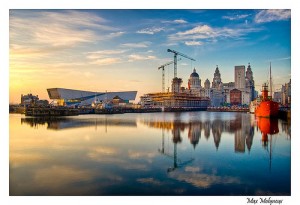
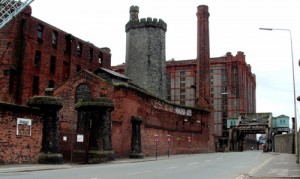
The Herculaneum Docks, South Liverpool - industrial heritage no longer with us (from the World War I Document Archive)
Industrial Heritage at Risk is this year’s Heritage at Risk theme, launched today by English Heritage in conjunction with the Council for British Archaeology (CBA) and the Association for Industrial Archaeology (AIA). The annual Heritage at Risk survey launch is in October.
Liverpool is not always closely associated with ‘industry’ in the same sense as the wool industry of Manchester and Lancashire, or the coal industry of Yorkshire. Liverpool’s World Heritage Site is the ‘Maritime Mercantile City‘, and even though the Exchange buildings and the Customs house are closely linked with industry on a wider scale, it’s more accurate to class it as ‘commerce’.
However, commerce is difficult to see embodied in archaeology or buildings, and the buildings English Heritage are talking about are as often as not a product of industry, made possible by the Industrial Revolution, rather than playing a part in industrial production itself.
In fact, much of Liverpool’s built heritage fits this bill rather well.
[There is a lot more detail about the development of Liverpool’s small-scale industries (potteries, mills and the like) in the Liverpool and Toxteth sections of the Historic Liverpool website (or search for ‘mill‘ or ‘pottery‘ to see a whole lot more).]
Liverpool’s industrial heritage at risk
All the sites at risk in Merseyside can be seen via a search on English Heritage’s Heritage at Risk microsite: . You can then break the list down into classes of ‘at risk’ heritage, including buildings, conservation areas, scheduled monuments and registered parks and gardens.
But English Heritage wants a wider debate on this, rather than just promoting the current list of at-risk buildings. So, start here if you want (in the comments!) or visit the Industrial Heritage at Risk Flickr group.
Alarmingly there’s a photo of Albert Dock in the photo pool, but as I say this discussion is about a wider appreciation of industrial heritage. Remember, the Albert Dock was once indeed at risk of demolition, and is one of the best reminders of how historic buildings can be brought back into use successfully as modern developments.
The aim of the Flickr group is to bring people together to discuss which parts of their industrial heritage are most-loved, and those which perhaps should be added to the list come October. You can, as with any Flickr group, add photos and comments of your own.
So this is a call from one Liverpool historian to others: get your photos on there and promote the best of Liverpool industrial archaeology! Here’s a few suggestions to get you thinking:
Albert dock (you can never have too much Albert Dock)
Stanley Dock and the tobacco warehouse
Liverpool Maritime Mercantil City World Heritage Site (plenty of room for discussion)
Lime Street Station and the railway and tunnels to Edge Hill and beyond
On a national scale, and a counterpart to the HER, is the National Monuments Record (NMR) in Swindon, which has been part of English Heritage since 1999. The NMR holds millions of photos, plans and other documents, some of which it puts online.
When I first started work for the NMR I played a small role in the expansion of ViewFinder, and this is still my favourite English Heritage site. One of the best, but little-known features are the entrancingly-titled Photo Essays, one of which is called Liverpool: a port of world significance.
This is a short introduction followed by 12 images taken from the NMR’s archives, with captions written by Keith Falconer, one time Head of Industrial Archaeology for English Heritage.
It was written a little while ago now, and some of the pictures feel a little out of date (the view across from the Albert Dock to the Pier Head seems to be missing… something) but it’s refreshing to read about the city’s history and architecture from an author who doesn’t appear to feel the hot breath of passionate Scousers looking over his shoulder. He gives the city its due without hyperbole, and acknowledges that it was, indeed, a city of world importance.
As well as the Pier Head and Stanley Docks, Falconer takes in civic buildings like the Town Hall, and the under-appreciated Oriel Chambers, one of the first iron-framed buildings in the world.
Once you’ve read that, there are a couple of other Photo Essays which might take your fancy, but don’t forget to look at ViewFinder’s entire collection of Liverpool photos. There’s stuff from over 150 years of history, including photos that aren’t that old, but are already becoming important records of Merseyside’s past.
It seems only yesterday that I was bemoaning the uncertainty of the future for Liverpool’s built environment (oh, wait… it was).
Now, on the same day that we can celebrate the historic Stanley Park and 16 other Liverpool parks getting a Green Flag award, there are confusing rumours of Peel Holdings’ plans to transform Merseyside’s docklands.
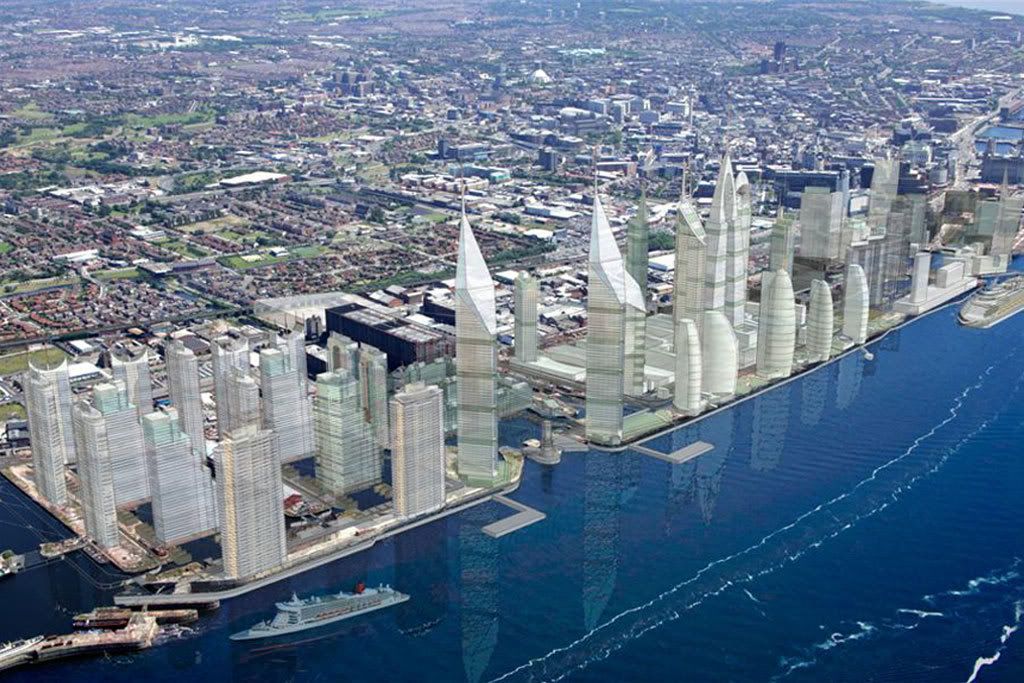
English Heritage have expressed their concern that the schemes – which originally wanted to erect dozens of skyscrapers across both waterfronts – would damage the context of the World Heritage site, centred on the Three Graces.
In response, Peel have scaled back the plans, now with just two groups of tall buildings between Princes and Clarence Docks. The number of tall buildings is lower than was planned in 2007, with the group at Clarence Dock being reduced from 15 to seven towers.
It’s nearly here. You don’t like it, I don’t like it, but the controversial Mann Island development is forever nearer completion. The Liverpool Echo were granted exclusive access inside.
There’s mention of exhibitions, which must be good (though whether this will be a compliment to or a conflict with the new museum remains to be seen), and then there are the “half a dozen top restaurants and … major chains”. What Liverpool waterfront certainly needs are more major chains, right?
But this blog is about history, development and change, not economics (and certainly not shopping). What it’s also about is landscape, and it’s the context of this building which troubles me and plenty of other people.
As modern architecture goes, I quite like it. Sleek, modern, shiny, it’s like a big iBrick. It’s easier on the eye than the One Park West apartments across the Strand with their spidery framework on display.
Plans are afoot to turn the north docklands into a new Shanghai, and the area towards Stanley Dock in the north is a bit cut off, though development is moving in that direction. If this building had been put further north, although it would have clashed just as horribly with the massive brick warehouses, it would have been the right height for the city, keeping that intimate, human-scale feel that we all enjoy about our town, and increased the modern variety that those docks are getting.
However, keeping it away from the Three Graces would maintain that area’s all-important coherence, of proud architecture which has stood the test of time.
What do you think? Is this the right building in the wrong place? Where would you prefer to see it? North Liverpool? Kirkby? Shanghai?
Although Ordnance Survey maps chart the most significant changes in Liverpool’s history, older maps often are unique. They show details or aspects which no other map does, and can often show what was important to the map-maker. You can’t beat old maps for laying bare the great changes of a city like Liverpool.
Modern maps are often much more ‘objective’ in comparison. But old maps are still of use to the local historian, at the same time as being beautiful objects.
Early Liverpool Maps
Liverpool developed from seven streets, laid out at its founding in 1215. Soon there was a castle, a chapel and the Tower, a fortified house built by the Stanley family in 1404. Maps of this period (1205-1700) do exist, though most of them were drawn later. Here are a few of the easiest plans of Liverpool to get hold of.
Liverpool from the River in 1650, by William Ashton
William Ashton included a simple sketch (above) of 17th century Liverpool in his book ‘Evolution of a Coastline’ in 1920.
Ashton also drew a top-down plan of Liverpool (see my post Lerpole 1572 for more detail on this map)
Liverpool (‘Lerpoole’) in 1572
The book itself has recently been reprinted, so if you want a higher resolution copy you can pick up ‘Evolution of a Coastline‘ at Amazon.
Genmaps
Cartophilia (once a Rootsweb-hosted site called Genmaps) has a page on Lancashire maps. There’s a huge range, so I’ve collected the Liverpool entries in the following table. In case newer maps get uploaded to that site, I recommend going to the original page and using your web browser’s inbuilt search function to search for ‘liverpool’.
Note: the Cartophilia page has many, many fewer Liverpool maps than the original Genmaps one. I’ve added links to the new Liverpool maps on there, and kept the entries below for the maps that were on the old page, but not the new one. For those maps, I’ve removed the links, but left the rest of the information there. If you know of a link to any map below, please let me know in the comments!
From Stanford’s Parliamentary Dictionary of England and Wales
Lancashire
1809
John Cary
Liverpool, Warrington, Leigh area
1809
John Cary (detail of map above)
Liverpool
1832
Lt. Robert Dawson in Plans of the Cities and Boroughs of England and Wales: shewing their boundaries as established by the Boundaries’ Act, passed 11th July 1832
Liverpool, street plan
c.1833
(includes plan of Liverpool in 1729) Society for the Diffusion of Knowledge. This is a hand-coloured (but smaller) version of my map by Mickleburgh, completed with engraved building profiles along the bottom.
J.Bartholomew (detail from The Towns of England in The Times Atlas)
Some of them are high resolution, and some not. Others have links to higher resolution versions of extracts below them.
Lancashire County Council
Lancashire County Council has the best collection of old maps for any student of Liverpool history. It runs from a reproduction of Gough’s 1320 map, through all the major map makers: Speed, Yates, Greenwood, Hennet.
Greenwood’s map of Lancashire from 1818, is undoubtedly the best! The link points to the National Library of Scotland’s interactive map. There used to be a colour version of this on the Lancashire Council’s website, but it’s now only available on the Internet Archive.
Old Maps of Liverpool
It will take a fuller article to go into all details hidden in maps like these. For us today they provide an immediate visual visit on the past, easy to interpret. For this reason one of my favourites has to be this 1833 Society for the Diffusion of Useful Knowledge map (if only for the name!) I now have a high resolution, zoomable version of this map.
It shows quite a lot of detail, including Bootle Castle at the end of Regent Street, an unfamiliarly station-free Lime Street, and is detailed right out to Kensington (the edge of the city back then). Click on the map to zoom in.
Oldest of the old maps
Finally, I want to mention a map included in the modern edition of The Calderstones by Ron Cowell. The map was made in 1568 to help solve a boundary dispute between Allerton and Wavertree. Not only does it show the Calderstones, but it also shows the mysterious Rodgerstone and the Pikeloo Hill.
The Rodgerstone might have been a single standing stone, while the Pikeloo Hill could be a burial mound. The Pikeloo Hill could even have been as large as Silbury Hill, a prehistoric mound in Wiltshire.
Not only does this seem to be the oldest map of the Liverpool area. It’s also a tantalising glimpse of a prehistoric complex now long lost. The map isn’t online, so if anyone has a high resolution scan, do get in touch.
Well, that rounds off this brief excursion into Liverpool maps. There are certainly some I’ve missed, so please share your own sources in the comments!
Image: Extract from the Greenwood map of Lancashire, 1818, used with the permission of the National Library of Scotland, available in full on the NLS website. A low resolution, but coloured, version is available from Lancashire County Council Old Maps of Lancashire website (you’ll need to scroll down the story to find Greenwood).
Peel’s Liverpool Waters scheme has reached another milestone with their plans for Birkenhead Docks being submitted to the local council. The Northbank east section has already been approved, but this East Float part is apparently the UK’s largest planning application.
Peel hopes the Mersey estuary will rival Shanghai and Sydney once the development is completed, and the artists’ impressions I’ve seen certainly show a massive change from what the area looks like now.
Perhaps I’m being old-fashioned, or at least conservative, but to me this will completely change the character of Liverpool and the Wirral. I’m not opposed to big cities per se, but what I love about Liverpool is the human scale of it all. Say what you want about the Mann Island development and the new Liverpool Museum, but the size (if not the design) of these buildings fit with the character of Liverpool. So does Liverpool One. The forest of skyscrapers promised by Peel will remove that feeling, and alter the balance and focus of the river bank. No longer will the Three Graces be the prow of the good ship Liverpool. All eyes will be on Peelsville.
I’d dearly love to see the vast swathes of dereliction in Liverpool and Birkenhead brought back into use (see for instance my earlier posts on Stanley Dock). But whether historic buildings are brought into use or new development takes place, I’m sure there are better, more individual ways of doing it. Discussions on Yo! Liverpool certainly show enthusiasm for the project, although there are some who want tougher questions asked.
Perhaps the new version of Liverpool – Peel’s version – will be a hugely exciting place to live and work, but I fear that I’ll feel a little lost in it all. The plans concentrate in the north docks, so perhaps both towns can successfully contain their ‘scraper cities’. What do you think?
Liverpool’s own scrutiny committee
Speaking of my recent Stanley Dock article, I was contacted by Peter Baines, Local Government Improvement Adviser for English Heritage, who pointed me in the direction of Liverpool City Council’s Regeneration Select Committee. Peter tells me that “these committees hold in-depth reviews on all manner of policy areas and make recommendations to the Council’s Executive / Cabinet about how things can be improved”. This page shows how open this committee is, with agendas and minutes posted for all their meetings. The page also lists their responsibilities, which to me look like exactly the kind of progress and development we should be after.
Thanks, David! Good to know we have these committees!
When Christmas shopping gets a bit much…
Liverpool.com has a great little article on the best pubs and bars to be found in the city centre. From the Grapes and Carnaevon Castle to the Richmond and the Globe, the list gives away some hidden gems in Liverpool’s pub landscape. Have you tried any?
Liverpool Landscapes and Historic Liverpool go social!
If you’re a regular reader (and if not, why not?!) then you may have noticed the headlines in the left-hand bar. These are my posts on the new Historic Liverpool Twitter page! Click straight through to the stories from this blog, or follow all the updates at @histliverpool.
You can also keep an eye on all the links used in this blog by going to the Historic Liverpool Delicious page. This is a site where I can publicly bookmark interesting pages, and keep them collected in one place.
Both these pages can be viewed without opening an account, and you can keep up to date with each page by adding their URLs (Delicious, Twitter) to a feed reader.
The Observer reports on a survey by McBains Cooper which suggests that giving Grand Designs-like makeovers to Britain’s vacant listed buildings could help with the shortfall of up 1 million homes.
The suggestion is that the hundreds of listed buildings which are currently out of use could be converted to flats and houses. However, the main objection is the red tape and hassle that owners expect to have to go through to get plans accepted.
Stanley Dock by Paul Holloway, via Flickr
Having seen, and mapped, the listed buildings most at risk in Liverpool, according to English Heritage, I know that a great many of them lay dormant, without use and without any plans for the future. My favourite is the tobacco warehouse at Stanley Dock. This is a colossal building, and identical to all intents and purposes to the warehouses at the King’s Dock which are now plush and expensive footballers’ homes, and which ensure the preservation of these globally important structures. There seems no reason why the Stanley Dock warehouses couldn’t be put to similar use. New flats are also found all along Waterloo Road, occupying former derelict buildings. Perhaps it is only a matter of time before Stanley Dock is converted. Maybe the owner has been waiting for the best time. But these kinds of projects need to be started sooner rather than later. How many flats could you fit in that warehouse, plus shops, parking and maybe offices on the ground floor? Granted, at the moment these buildings are a tad out of the way of the city centre, but the location must be attractive to many who would save on transport costs to the offices and shops in town.
There also has to be the one project which starts the regeneration of the entire area all the way up Waterloo Road to Nelson and Huskisson Docks. The main thing to remember, however, is that the housing shortfall is not with the wealthy King’s Dock flat owner types. It’s with the thousands of families who can’t afford a house, so it would be no good to create another ‘exclusive’ gated community. Could a Stanley Dock scheme both ensure the preservation of the warehouse structure and provide a more accessible housing scheme than Kings or East Waterloo Docks?
Of course, there are other vacant listed buildings in Liverpool, crying out for regeneration. What buildings in your area could benefit from such a scheme?