Skip to content

A quick news roundup of Liverpool history

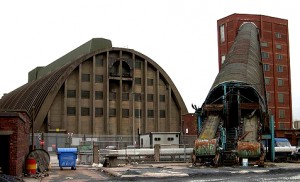
Sugar Silo & Conveyor, Huskisson Dock, Liverpool

Sugar Silo & Conveyor, Huskisson Dock, Liverpool, by David Barrie via Flickr

Hello! It looks like my hopes for getting the second historic maps article to you this week have come to nought. It’s amazing how much time arranging a wedding soaks up!

So, before I head off on honeymoon, as I can’t bring you the usual detail of stories, I’ll resort to the bulleted list:

  • The BBC have shown archive footage of the 1960 fire in Henderson’s department store. A link to the Inside Out programme which showed the footage is available from the BBC Liverpool article on the fire.
  • One of the earliest railway tunnels – Bourne tunnel in Rainhill – has been listed at Grade II. Buildings are listed if they are of nationally significant architectural value.

Well, I hope that can tide you over until mid-April, when I return. I promise much more exciting articles in the weeks and months to come, on all aspects of the history of the city of Liverpool. Until then: au revoir.

Liverpool benefited from Capital of Culture year

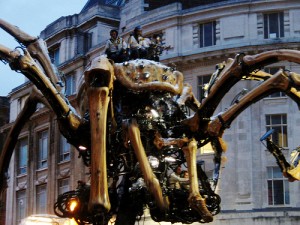
La Princesse, by Eric the Fish (2010), via Flickr

La Princesse, by Eric the Fish (2010), via Flickr

It’s been a little while since I posted. Just because the previous post was the 100th (you have been counting, right?) doesn’t mean I’m quite finished with Liverpool Landscapes. I’m currently drafting the second Liverpool Maps post, and also preparing for a rather important personal event coming in the next few weeks. So I hope to get that post to you very soon, and then there’ll be another short gap before you hear from me again (say, late April).

But before I go, here’s a couple of snippets for you to enjoy.

Capital of Culture a success

Impacts 08, as regular readers will know, is a study being carried out  by the University of Liverpool and Liverpool John Moores University to study Liverpool in the wake of 2008’s Capital of Culture.

They’ve already published a couple of reports, but the latest one gives details about the overall experience of the CoC title. A few choice stats (taken from the Guardian report):

  • 34% increase in tourists (to 9.7m);
  • 85% of Liverpool residents said it was a better place to live;
  • 97% of visitors said they felt welcome.

This is a positive reaction, as there were many detractors in the years leading up the event. I felt, as the Guardian reports, that there were many who worried what would actually happen. There were forever the cynics who’d already decided we’d cock it up.

I remember one Pythonesque encounter on Radio Merseyside:

“One revolutionary pop band does not make a Capital of Culture.”

“What about the football teams?”

“Well, yeah, but two world class football teams and one revolutionary pop band do not make a capital of culture.”

“And the architecture?”

“OK. 2,500 listed buildings, two world class football teams, one revolutionary pop band…”

“And two of the greatest cathedrals-”

“…and two of the greatest cathedrals in the world do not make…”

And so it went on. I paraphrase, of course, but that was the gist of the thing.

Anyway, you can download the report from the Impacts 08 home page.

Liverpool Town Hall

I’ve pointed out Pete Carr’s photography before, but that’s no reason not to mention another. Here’s a great one of the town hall. Pete admits it’s hard to get a shot of the hall without Martin’s Bank in the background, but the bank’s such a great building that it serves as a classy backdrop to this tight shot.

Dickie Lewis plans afoot already

Lewis’s has only recently announced its closure, but already plans sneaking out about what will come after it. Still no word on whether the shop itself will be ‘resurgent’ in the new development, but plenty of comment, so I’ll leave to to pop over to those sites for a read.

Plans for a ‘Central Village‘ have been on the cards for a few years already.

Robin Brown on the Liverpool Culture Blog is right to worry about what will go in the new ‘Central Village Liverpool’ . What with Liverpool One and the new developments from Paradise Street up to Renshaw Street, Liverpool is at risk from each area pulling customers away the others. If this development is to work, it will have to have its own distinctive character.

However optimistic we are, Liverpool has only got so much money to spend, especially at the moment. As this is near Lime Street, there is a good chance Central Village will attract visitors from outside the city, but if it apes the rest of the new developments, Liverpool will lose its character, and it’s often bold independent shopping soul.

Good luck to it.

Museum paid £750,000 for historic view, and visitor numbers up on 2007

Photo of the roof of the atrium in World Museum Liverpool

World Museum Liverpool, by Secret Pilgrim via Flickr

First some museum news: the Echo is reporting that National Museums Liverpool had to pay landowners Downing £750,000 as the new Museum of Liverpool building broke a covenant drawn up in 1963.

The covenant dictated that no building be constructed within 40 feet of the River Mersey, and any building here would not be more than 40 feet tall. This was to maintain the lines of sight between the Port of Liverpool building and offices at the Albert Dock. This document was signed in 1963 when the Mersey Docks and Harbour Board sold the land the museum now stands on to Liverpool Corporation.

It seems that NML’s David Fleming chose to pay the money upfront before Dowling were tempted into suing for a predicted £70,000.

Visitor numbers up for Liverpool museums

Better publicity for NML comes in the form of visitor numbers to all the museums on Merseyside, which rose to 2.2m in 2009 from just over 2m in 2007.

Of course, 2008 was going to take some beating, so it’s good to know that the trend from the last ‘normal’ year is a positive one. You can only imagine that with the new museum next year, visitor numbers will increase again.

More details and figures for the individual museums are available on the Art in Liverpool blog.

Lewis’s lives on – for a little while longer

Now that Lewis’s has announced it’s closing down, memories turn to its ‘golden years’ in the last century.

A new exhibition by photographer Stephen King is being shown at the Conservation Centre, focussing on the fabled ‘Fifth Floor’. This is where the old cafe was, along with the biggest hair salon in the world. It’s also home to an amazing range of (now) retro design – bright colours in the post-WWII era, yellow walls, orange ceilings and blue chairs, and egg-shaped hair-dryers and 1950s lino floors.

Photographs also include portraits of Lewis’s employees past and present, to breathe some life into the eerie space.

The exhibition runs from 26th February until 30th August. You can follow the exhibition on the Lewis’s Fifth Floor blog.

Abbey Road studios finally listed

You may be aware of the current saga of Abbey Road studios in London; its future uncertain while rumours flew that it would be sold off by owners EMI.

Well, the Culture Minister Margaret Hodge has announced that she would be taking on board English Heritage’s recommendations, and would be listing the Georgian townhouse which contains the studios.

English Heritage first proposed that the building be listed in 2003, but had been ignored until this great publicity opportunity fell at the minister’s feet. Even EH had originally been reluctant to recommend listing, but current listing criteria include ‘historic’ as well as ‘architectural’ significance. And Abbey Road certainly has that.

Web Sites for Local History

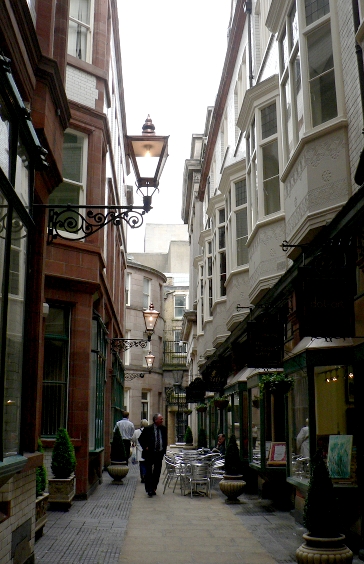
Queen Avenue, off Castle Street, by M D Greaney

Queen Avenue, off Castle Street, by M D Greaney

Over the past few weeks I’ve come across a handful of very interesting looking sites for those of you with a local history interest. The best thing about them is that they’re after your input, so pop along and see what you can contribute!

Building History is a specialised wiki site, much like the (in)famous Wikipedia and the Liverpool Wiki. It encourages users to submit information about any road or building to its database, even the one you live in! Almost 200 roads and nearly 300 buildings have been added, and the site’s only been online since October 2009.

All you need is an email address, and you can get going. The Warwick page is the most complete, so use that as a template. Liverpool is there, waiting for someone to add something, though note that it’s placed in Lancashire!

For those privacy-concerned individuals (like me), it’s good to know they only allow publicly-available data to be added (census data, for example).

Liverpool Signs, Mosaics, Words and Graffiti is a set of photos on Flickr which collects together a huge number of images of… well, signs, mosaics, words and graffiti.

The most obviously interesting ones to readers of this blog are the ancient signs painted on the sides of warehouses and shops, or the tiled signs such as this Liverpool Co-operative sign in Bootle. But the collection also includes a huge number of other examples, from the formal to the most informal.

Of especial interest to me, as a ‘hidden landscape’ geek, is the boundary marker from Smithdown Road. I’m not sure whether this is a township boundary post or one for the London and North Western Railway (that’s the stamp on the marker), but Smithdown Road crosses the old boundary between the Toxteth and Wavertree townships.

Two other Flickr Groups you might be interested in are the Old Liverpool and Secret Life of Smithdown Road groups.

Finally, we have the Open Plaques project. This, in its own words, is “a service that aims to find and provide data about all the commemorative ‘plaques’ (often blue and round) that can be found across the UK and worldwide”.

You can browse their database via peoples’ names, places, or organisation, and the site wants all the plaques photographed, tagged with their geographical location, and have their colour identified. There’s a neat little graph on the home page letting you know how they’re getting on.

The data comes from a variety of sources (including English Heritage’s blue plaques site and Freedom of Information requests) which have been cleaned up for presentation on the site.

You can help them by getting in touch, or taking a photo of one and uploading it to Flickr. If you tag the photo correctly (as explained on the site) it will appear next to the relevant entry. Brilliant! All the data is free for you to reuse, and the maps are created using OpenStreetMap. You can follow the project via Twitter: @openplaques, or on their .

There are nine plaques for the city of Liverpool.

Liverpool places of worship receive £373,000 repair grants

Three listed buildings in Liverpool are amongst over 150 to receive money from English Heritage and the Heritage Lottery Fund’s Repair Grants for Places of Worship scheme.

The Church of All Hallows (£103,000), St Michael in the Hamlet (£199,000), plus the Princes Road Synagogue (£71,000) were all beneficiaries of the latest round of grants, which totalled £15.7 million this year. The money will be spent on repairs and restoration of the buildings, as well as anti-vandal measures where necessary.

New Museum is empty, Liverpool Map goes on display, work begins on Liverpool’s Garden Festival site

Photo of side of the New Museum of Liverpool based at Pier Head Liverpool.

The keys were handed over to National Museums Liverpool from the developers last week, and now the pristine Museum of Liverpool is preparing for the installation of its exhibits ahead of the 2011 opening. The Liverpool Echo has a great slideshow of the museum, including the main entrance, the giant picture window, and the central spiral staircase.

You can also sponsor part of the Jura stone cladding, or one of the seats in the auditorium. Just pop over to www.liverpoolmuseums.org.uk/about/development/mol for more information.

I’m looking forward to seeing it when it opens!

Liverpool Map to go on display

Speaking of the museum, a new fused glass map which will take pride of place in the galleries when MoL opens next year is to go on display at the Daily Post’s offices in the city centre. There’s a blog on the Daily Post web site to keep you up to date with progress with the map.

Now if only they’d do an electronic version I could stick on my site!

Work begins on the International Garden Festival site.

After 26 years, work is finally to start on the site of the 1984 Garden Festival. The Oriental gardens will be restored, lakes dredged and undergrowth cleared. Plenty of people in the Liverpool Echo article are ‘delighted’ at the ‘milestone’. 600 homes were built straight after the Festival, and Pleasure Island gave many a young schoolkid a fun Bank Holiday in the 1990s, but developers Langtree hope that this latest phase of building will create a worthy leisure facility for Merseyside and kick-start the collapsed apartment project from 2008.

Criticism for Liverpool regeneration plans, and new blog on Liverpool’s lost historic buildings

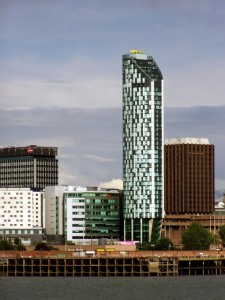
Photo of West Tower, Brook Street Liverpool, as viewed from the Seacombe promenade

West Tower, Brook Street, Liverpool, by E Pollock via Geograph

We’ve moved a step closer to Peel’s vision of ‘Liverpool Waters’ with funding being secured for the 54 storey Richmond Properties/Y1 tower towards the north docks, at the junction of the Strand and Leeds Street. It’s 25m taller than the current tallest tower, Tower West, but has been redesigned (again) after a failed attempt at getting planning permission in 2007.

Having failed to get the sleek design past the Council planning committee, it seems that the architects have thrown a bucket of Sticklebricks at the south side, to see what sticks (check out the third pic in the slideshow via the link above). Comments in the Architect’s Journal include the terms ‘pig ugly’, ‘hubris’ and ‘shoebox’ (though the third of these is a Wayne Colquhoun comment, so pinches of salt all round).

CABE criticise Pathfinder scheme

Further criticism for Liverpool’s attempts at regeneration come from Colquhoun’s arch enemies, the Commission for Architecture and the Built Environment (CABE). The commission has hit out at the New Heartlands Housing Market Renewal scheme, particularly parking courts and the quality of housing. SAVE’s Will Palin added to the judgment, claiming that “swathes of good Victorian terraced housing been emptied and left to rot”, to be replaced by inferior buildings.

New Pictorial History of Liverpool

OK, enough about planning for now. Adrian McEwen (via Twitter) pointed out the new Streets of Liverpool website.

This blog brings you views of Liverpool from across the 19th and 20th Centuries, with a paragraph or two about what you can see in the photos. The February 8th post is all about Lost Churches of Liverpool, which is a kind of post-script to the 2001 book The Churches of Liverpool by David Lewis, which was published by the blog author.

It’s great to see some little admissions of what the publisher would have liked to have done better in the book (an index, for example), but to make up for this (perhaps!) future blog posts will give us photos of the greatest losses to the city, starting with St George’s Church, which stood where Liverpool Castle once was, and where now we find the Victoria Monument.

The most recent post as of this writing does a similar service to other lost Liverpool buildings, including arguably the most-missed: the Customs House, which was needlessly demolished in the post-Blitz redevelopment.

Make sure you keep an eye on this new blog – it promises to be a good one!

Ordnance Survey Maps for Local History Research

Ordnance Survey maps are some of the most well-known sources for local history. Here we find out how to get them.

Read more

Maps for Local History Research (part 1: Modern Maps)

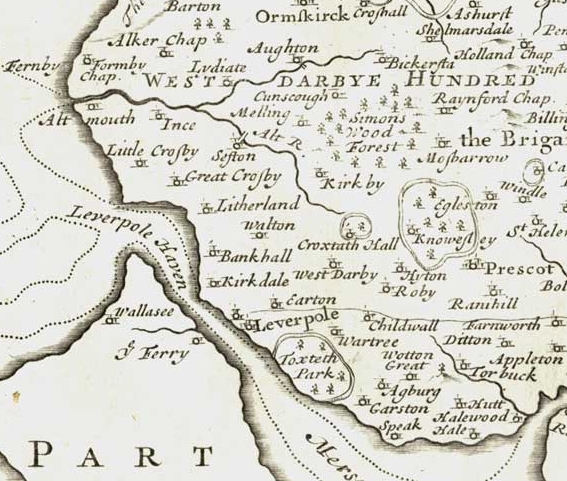
Extract from a map of Lancashire, by Robert Morden, 1695

Liverpool, from Lancashire, by Robert Morden, 1695

This is the first in a series of posts which will hopefully help you research the local history of your area, whether it’s Liverpool or elsewhere. It’s about maps, as my own main site, Historic Liverpool, is based on maps. Part 1 will focus on late 19th and early 20th Century maps.

Beginning Map Research

Maps are an amazing way to research local history. For one, you can start with a recent map, and then by looking at increasingly older editions you can see in reverse the changes which have happened over time. You start with something very familiar, and gradually work your way back. Sometimes, an unbelievable amount has changed in very little time.

But whether you are researching Liverpool, or another city or any rural area of Britain, you’ll need to know what maps have been made of your location, and when they were made. Luckily, in this day and age it’s not hard to find them.

For every local historian, the first port of call must be the Ordnance Survey maps. You can pick up the current version for around £8, or a recent second hand copy off eBay for a fiver. Get a 1:25,000 Explorer map – these show individual buildings but cover enough area (unless you’re really unlucky!) for your needs.

That’s the easy part!

Now you have your anchor, your reference point for all the other maps you’ll be looking at. This serves as the base for your next step, which is known by the professionals as ‘map regression‘. This just means that you collect as many maps as possible, and work your way back through them and noting the changes. I’ll work through an example of this in a future post.

Getting a recent map of your area should be easy enough, but slightly older ones are going to be second hand, so you need to be aware of where to get them.

Second-hand and online maps

eBay

Your first choice for buying paper maps has to be eBay. I’ve bought almost all of my OS maps from this site, each for about the price of a pint of beer. eBay seems to be strongest with the years between 1930 and 2000, particularly 1950 – 1980. OS maps from across this period repeatedly appear for a couple of pounds. Keep an eye on this site so you’re ready when the right map appears, and also you’d do well to keep an eye on what you’ve already bought – more than once I’ve nearly ended up with two maps from the same year!

The list I have for Liverpool includes: 1947, 1952 (last revision 1947-9); 1961 (last revision 1958), 1964, 1978 and 2000. (For an excellent overview and samples of all the OS map series, see http://www.charlesclosesociety.org/osseries).

Older OS maps are a bit harder to find (see below), although occasionally a great find pops up on eBay. Luckily, there are ways you can get a look at OS maps without leaving the comfort of your own home. There are a couple of web sites which let you view old OS maps, and some of these are very nifty mapping sites in their own right.

Old OS Maps

Old OS Maps is a simple name belying an amazing little tool. Unfortunately there’s a big black hole where Liverpool should be. I’d scan in one of my own maps to donate it if only I had a big enough scanner! However, the site’s well worth a look, as it overlays a small modern Google map extract over the centre of the screen, overlaying an OS map from around 1925 to 1945 (depending on location). Have a look if your area lies outside Merseyside.

Leverpoole.co.uk

Leverpoole.co.uk used to be one of the best sites for Liverpool maps. However, most of the maps have been removed now due to ‘unauthorised use‘. This, like the much-missed Toxteth.net, used to be a fantastic resource. It’s a great shame that the owner, Tony Swarbrick, felt this action necessary, and a shame that his stuff was being used without his consent.

However, there is still the 1930s Philips Street Map of Liverpool on there. This is divided into squares, based on the original map gridlines, which are scanned in at a high resolution. There’s also a text index below the map if you know the rough area you’re after but can’t spot it on the map. And then you can click to enlarge the image, which is a great bonus!

Sites of interest on this map are the Overhead railway down the Strand, and the Chester Basin still open in front of the Dock Board Office.

As an aside, Leverpoole.co.uk also has a huge number of photos of Liverpool, which are great for researching listed or historic buildings.

Commercial map sellers

Getting maps off eBay, and viewing maps online are the cheapest ways to get the most common editions, but the following sites will sell you brand new reproductions of old maps. This includes difficult-to-find early editions.

Alan Godfrey Maps

This site publishes a huge list of maps of Liverpool and elsewhere. They’re paperback maps about A3 size, and extremely detailed (though that means they cover a small area). The strange thing about this site is the lack of illustration, and that once you click on links the text turns yellow, making them very difficult to see! However, the maps are an unparalleled resource, and are also sold all the time on eBay.

Cassini

Cassini are a large commercial map company, slightly reminiscent of the National Archives web site, and sells highly polished map products of all types. You can get downloadable or printed maps, and specify the area and period you want. There’s also a boxed set of maps of Liverpool, which comes in useful for the wide-ranging form of map exploring!

David Archer Maps

In many ways David Archer’s is a strange site. Again, a site with little in the way of pictures, and a shop which appears to take orders exclusively over the phone. Still, it’s these quirks for which I have a certain admiration. Take a look at the informal blog “A nice cup of tea and a chat about maps”: it’s quite a rambling but entertaining diversion into other map sites, Christmas cards and exhibitions. It also reveals that David’s a fan of free and open source software, which always gets the thumbs up from me!

There’s a massive list of all the maps they stock, but if you don’t know what you want, or can’t find it, then they encourage you to contact them.

Last Words

This has been a fairly lengthy overview of map sources. There are many more online, but these are the few I keep going back to. In the next part of the series, I’ll have a look at older maps, which are often a lot harder to find.

Of course, if you know of better places to get hold of old maps, share it in the comments!