Skip to content

95,000 Aerofilms aerial photos to go online

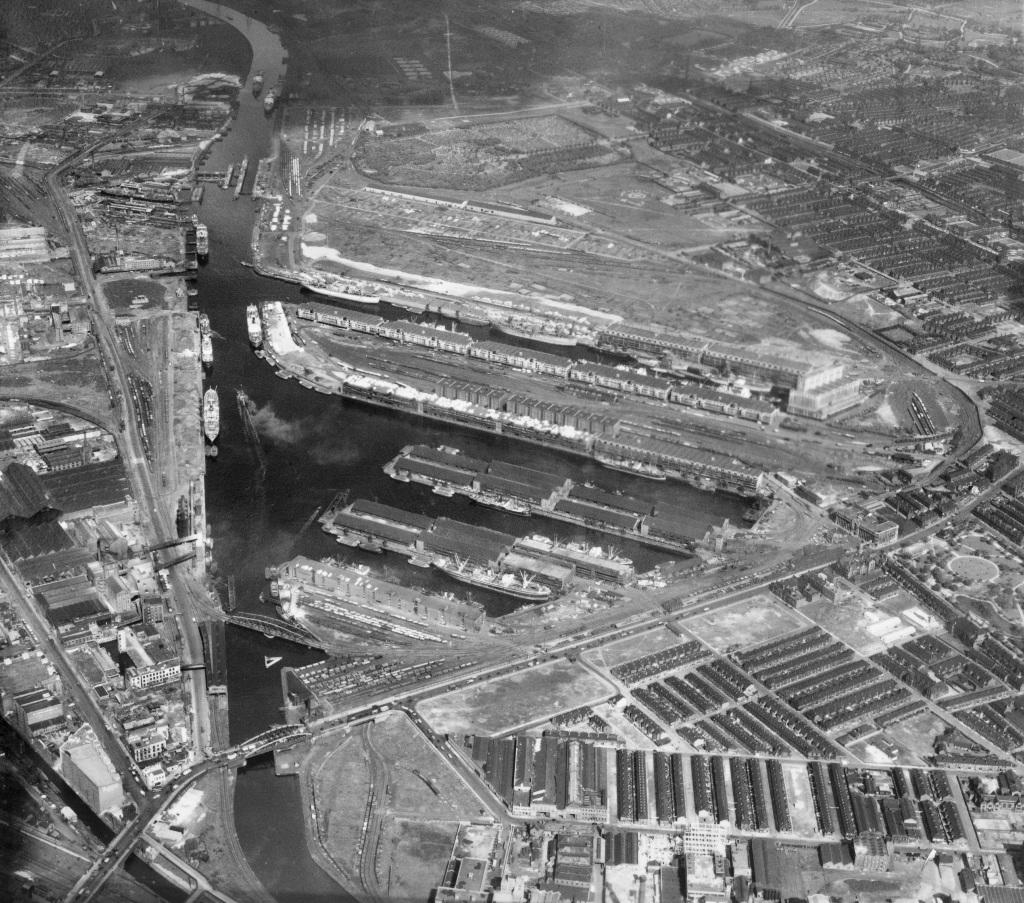
Aerial shot of Manchester Ship Canal taken by Aerofilms in 1947

The Heritage Lottery Fund have recently agreed to grant £1.75 million to help put an amazing collection of aerial photographs online.

The photos will be conserved, scanned and made available on a new website, to be called Britain from Above, and is a collaboration between English Heritage and the Royal Commissions on the Ancient and Historic Monuments of Scotland and Wales.

Aerofilms was a company set up in 1919 by veterans of the First World War, and flew across the UK taking over a million aerial shots. These are now held in Swindon, Edinburgh and Aberystwyth by the three main organisations involved.

The project will start digitising chronologically, and so will have photos from 1919 to around 1927 when the website launches in 2011. Once up, visitors will be able to search for images, and tag and add notes to them to create a ‘crowdsourced’ archive of information. This is going to be a pretty amazing resource – I’ve seen some of the shots (an example is above), and the Aerofilms collection kept growing until 2006 so it’s an important historic resource. Until the site goes up you can order photos covering England through the usual NMR channels.

For more details, contact aerofilms@english-heritage.org.uk, or sign up for updates on the English Heritage news page. Of course, as soon as I hear any more myself you’ll hear about it here!

New Appearance for Historic Liverpool

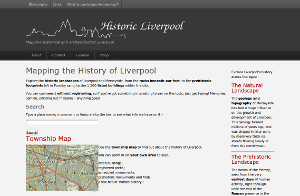
Screenshot of Historic Liverpool with a new Drupal theme

Historic Liverpool with its new Drupal theme

Just thought I’d write a short note to let you know that the appearance of Historic Liverpool has changed!

I’ve changed the colour scheme – the Drupal Theme for those web developers out there – because there were some issues with the last one. I’ve still got to do a bit of tweaking to make sure my particular content fits the new clothes. It’s mostly the same, however, so all the menus and text haven’t changed.

I’d like to know what you think. It feels a bit more professional than the last one, and I really like the way it looks, but the most important opinions are those of the people who use it, so do let me know what you think.

The Week in Liverpool

Still from a recent Hovis ad, filmed in Liverpool

From a recent Hovis advert, filmed in Liverpool

After last weekend’s exciting Heritage Open Days, there’s been a bit of a lull in history-related things this week. However, in traditional web log style, here are a couple of links you’ll find interesting:

  • Capital or Culture: you decide – “A new documentary is being shot in the city – and city creatives are invited to take part. The question: what did the Capital of Culture ever do for you?” (from the wonderful Seven Streets blog);
  • Liverpool Adverts: a couple of adverts you may or may not have noticed were filmed in Liverpool. My biggest surprise – that class Coca Cola ad was filmed in St. George’s Hall! (also from Severn Streest, with contributions).
  • Memorial garden marks burial site of Williamson Tunnels creator – a memorial garden for the Mole of Edge Hill has been completed. (From the Liverpool Echo.)

Well, that’s all folks for now. See you next week!

Heritage Open Days in Liverpool

Screenshot of the Heritage Open Days homepage

The Heritage Open Days website has details of all participating sites across the country

As I mentioned in my last post, a number of sites are opening across the country this weekend as part of Heritage Open Days.

The highlight for me would be the Ancient Chapel in Toxteth, which has important connections not only with the history of astronomy, but also with the New World.

Although by definition single open sites aren’t strictly ‘lansdcape archaeology’ I thought I’d collect a handful of useful links for you showing coverage of the excellent selection of Liverpool locations and events you can visit this weekend (and this weekend only!):

If you’re visiting a Heritage Open Day this weekend (or you’re reading this having already been to one) do let us know what you think in the comments.

Liverpool reservoir open to the public for just one day

High Park Street Reservoir in Toxteth is to be open to the public for just one day as part of English Heritage’s Heritage Open Days. There are a lot of buildings open in Liverpool as part of Heritage Open Days this year, and the High Park Street Reservoir can be seen as part of the Toxteth Town Hall event.

This listed building is currently owned by the Dingle 2000 Development Trust. The Trust tried to renovate it for use by the community, but rising costs forced them to put their plans on hold.

The reservoir is one of many which were built in the Victorian period to serve Liverpool once it became clear that the natural local sources (wells, streams, springs) were not up to the job of supplying a growing city.

Water for Liverpool

In the dim and distant past, villages would have been established on a site which had certain essentials: food, shelter, a defensible area, and most importantly, a water supply.

However, as the industrial revolution gained pace, and cities like Liverpool, London and Manchester became the centre of huge swathes of immigration and population increase, the strain on the water supply became unbearable. Adding to this were the demands on water from industry itself – all those coal-fired steam engines needed a constant water source.

So from streams, wells and springs, water supplies developed into reservoirs, pumps and dams. Mather’s Dam and Jackson’s Dam near central Liverpool had taken water from a stream to feed industry since the 17th Century. However, by the end of the 19th  Century these small localised sources were not enough, and schemes to alleviate shortages were planned.

Rivington Reservoir below Anglezarke Moor in the Pennines was constructed between 1852 and 1856. At the same time water fountains were appearing across Liverpool and more wells were being sunk throughout the city. Reservoirs like that on High Park Street were also built at Aubrey Street, Breeze Hill, Dudlow Lane, Kensington, Speke, Torr Street and Woolton (on the aptly named Reservoir Road).

High Park Street reservoir was built in 1855, while the Rivington building project was under way. The walls are four foot thick, and would have been lined with bitumen to create a watertight seal. Nine inches of brick were placed inside this bitumen. Towers were attached to some of these reservoirs to improve the ‘head’ of water – the water pressure needed to save on the need to pump. High Park Street has such a tower, and the whole structure is now a listed building.

Recommended Reading
Underground Liverpool by Jim MooreA lot of the detail in this article comes from Underground Liverpool by Jim Moore (1998, Bluecoat Press). The book includes a chapter called Water supplies in Liverpool which covers the Rivington project, the building of water fountains and local reservoirs, as well as later projects in Wales. There’s also summary information on the reservoirs mentioned above.

Local Knowledge, Dating Maps, and Liverpool’s building milestones

Dating maps can be tricky, but there are clues you can look for which will give you a rough idea.

Read more

Liverpool: a port of world significance

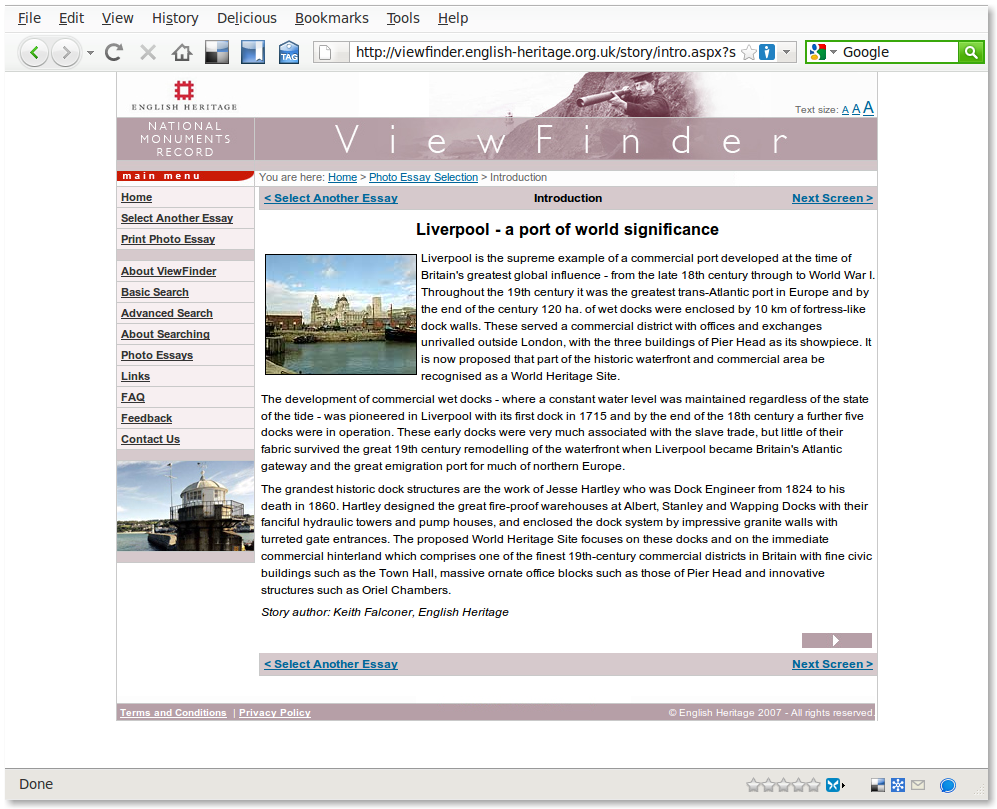
Screenshot of the introduction to a photo essay

Liverpool: a port of world significance, on ViewFinder

There are many sources of information we can use to investigate Liverpool’s history. There is the local Historic Environment Record (HER), the many libraries, and the local record office.

On a national scale, and a counterpart to the HER, is the National Monuments Record (NMR) in Swindon, which has been part of English Heritage since 1999. The NMR holds millions of photos, plans and other documents, some of which it puts online.

When I first started work for the NMR I played a small role in the expansion of ViewFinder, and this is still my favourite English Heritage site. One of the best, but little-known features are the entrancingly-titled Photo Essays, one of which is called Liverpool: a port of world significance.

This is a short introduction followed by 12 images taken from the NMR’s archives, with captions written by Keith Falconer, one time Head of Industrial Archaeology for English Heritage.

It was written a little while ago now, and some of the pictures feel a little out of date (the view across from the Albert Dock to the Pier Head seems to be missing… something) but it’s refreshing to read about the city’s history and architecture from an author who doesn’t appear to feel the hot breath of passionate Scousers looking over his shoulder. He gives the city its due without hyperbole, and acknowledges that it was, indeed, a city of world importance.

As well as the Pier Head and Stanley Docks, Falconer takes in civic buildings like the Town Hall, and the under-appreciated Oriel Chambers, one of the first iron-framed buildings in the world.

Once you’ve read that, there are a couple of other Photo Essays which might take your fancy, but don’t forget to look at ViewFinder’s entire collection of Liverpool photos. There’s stuff from over 150 years of history, including photos that aren’t that old, but are already becoming important records of Merseyside’s past.

Found any gems?

More ups and downs for Liverpool’s historic areas

Photo of two towers flannking a crane, in Liverpool

Liverpool Waterfront by Jim Media via Flickr

It seems only yesterday that I was bemoaning the uncertainty of the future for Liverpool’s built environment (oh, wait… it was).

Now, on the same day that we can celebrate the historic Stanley Park and 16 other Liverpool parks getting a Green Flag award, there are confusing rumours of Peel Holdings’ plans to transform Merseyside’s docklands.

English Heritage have expressed their concern that the schemes – which originally wanted to erect dozens of skyscrapers across both waterfronts – would damage the context of the World Heritage site, centred on the Three Graces.

In response, Peel have scaled back the plans, now with just two groups of tall buildings between Princes and Clarence Docks. The number of tall buildings is lower than was planned in 2007, with the group at Clarence Dock being reduced from 15 to seven towers.

Meanwhile however, more success for Peel over the Mersey, with the Wirral Waters project expected to be granted planning permission by councillors next week.

In other news…

OK, if all that was a bit much for one day, here’s a more… lovely story.

Heritage in a tough climate – what doesn’t kill you makes you stronger?

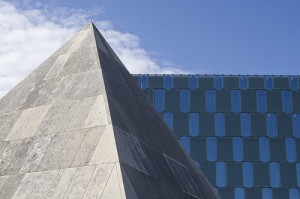
Photo of University of Liverpool and the Cathlic Cathedral, by Neill Shenton

This and That, by neill.shenton via Flickr

I can’t help feeling mixed emotions about recent developments for Liverpool’s heritage.

Yesterday the first object – a carriage from the Overhead Railway – was due to move in to the new Museum of Liverpool (although it was delayed by the weather). But then today we hear that the ever-present ‘current economic climate’ (my, am I getting more sick of that phrase every day) means that the National Conservation Centre, a favourite of mine, and Sudley House are at risk from closure.

The shutting down of the North West Development Agency isn’t looking like good news for our museums and other cultural institutions either. Though they plan to continue their previously NWDA-funded projects.

What is your point of view? Will our heritage projects be nipped in the bud? Or can the museums, galleries and theatres come out of this stronger?

What are the long term implications?

Liverpool Echo show first glimpse inside Mann Island shards

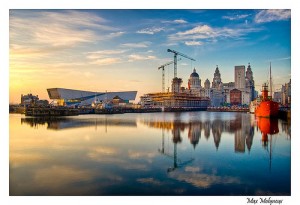
View of the Mann Island developments and the Pier Head, Liverpool

Another Graceful View, by Max/マックス via Flickr

It’s nearly here. You don’t like it, I don’t like it, but the controversial Mann Island development is forever nearer completion. The Liverpool Echo were granted exclusive access inside.

There’s mention of exhibitions, which must be good (though whether this will be a compliment to or a conflict with the new museum remains to be seen), and then there are the “half a dozen top restaurants and … major chains”. What Liverpool waterfront certainly needs are more major chains, right?

But this blog is about history, development and change, not economics (and certainly not shopping). What it’s also about is landscape, and it’s the context of this building which troubles me and plenty of other people.

As modern architecture goes, I quite like it. Sleek, modern, shiny, it’s like a big iBrick. It’s easier on the eye than the One Park West apartments across the Strand with their spidery framework on display.

But as news reports have highlighted recently, and other bloggers too in more personal channels, it has cut off expensive views from other buildings in the area, and destroyed the best, possibly most iconic view of the World Heritage Site from the said Strand.

Plans are afoot to turn the north docklands into a new Shanghai, and the area towards Stanley Dock in the north is a bit cut off, though development is moving in that direction. If this building had been put further north, although it would have clashed just as horribly with the massive brick warehouses, it would have been the right height for the city, keeping that intimate, human-scale feel that we all enjoy about our town, and increased the modern variety that those docks are getting.

However, keeping it away from the Three Graces would maintain that area’s all-important coherence, of proud architecture which has stood the test of time.

What do you think? Is this the right building in the wrong place? Where would you prefer to see it? North Liverpool? Kirkby? Shanghai?