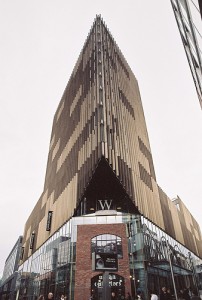
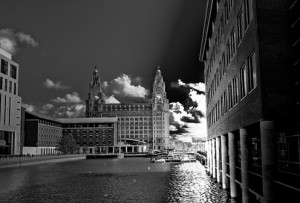
Cunard and Liverpool Buildings, Liverpool, Lancs., from UK Photo Finder
The National Archives have produced UK Photo Finder, a map-based tool for finding historic photos in your area.
The free tool is one of their ‘Lab’ projects, and so is open for comments and queries, though you may find a few bugs here and there (one user found it doesn’t work on Firefox for the Mac, and I’ve found it can occasionally refresh at annoying moments). Nip on to the site and have a play around.
There are 31 photos of Liverpool City Centre (although there’s a sneaky one of the Sefton Park Peter Pan statue in there); 5 attached to Huyton; and 18 on the Wirral.
The images are also shown attached to their record cards, keeping the photos ‘in context’ as archives, not just as photographs.
The photos at the moment are exclusively from the important Dixon-Scott collection, although I suspect that if this pilot is successful, they will extend it to other collections. I hope they do, as this is a really great site. Dixon-Scott is of great interest to readers of this blog, as he saw and recorded the changing landscape of Britain with the expressed aim of preserving what he saw as the disappearing landscape.
It’s also quiet similar to the independently produced (and ‘crowd-sourced’) Historypin project, which I also recommend you have a look at (and which also has a few bugs to iron out).
English Heritage are currently building up their catalogue of advice for those involved in the care of historic buildings. The latest guides concern places of worship.
EH’s first ever sample survey of England’s 14,500 listed places of worship, suggests that some 90% are in a good or fair condition but 10% are potentially in need of urgent repairs. In response to this research, English Heritage has produced a practical guide, DVD and website: www.english-heritage.org.uk/powar.
On this page are also links to case studies, so you can see what others in similar roles have done.
The mysterious town of Argleton, as a paper Google might have seen it, by Nefi via Flickr
I did recently promise some more entertaining blog content after the ‘historic environment’-heavy post this week. So here’s something to stick on your new iPad (or other less fancy PDF readers):
History of World Museum Liverpool
The institution currently known as World Museum Liverpool has a very long history. 150 years to be precise, and it’s celebrating in various ways. Download their free PDF called Liverpool’s Museum: the first 150 years.
I’ve not read the whole thing yet, but it’s already turning into a fascinating story of figures such as Thomas John Moore, William Brown, J.A. Picton and Lord Derby, who have all, in one way or another, left their mark on the city of Liverpool.
Lewis’s Slideshow
When you’re done with that, you should watch the ‘audio slideshow‘ commemorating the even older institution of Lewis’s, featuring voice-overs from former managers and employees, and with a soundtrack of the likes of ‘In My Liverpool Home’, which mentions old Dickie in passing.
There are some great images of the 1950s cafe interior, and the shop floors in days gone by.
Landscape Mystery
Now, you knew Google was getting too powerful, didn’t you? But now it’s creating whole English towns where none should be.
A trap to catch the unwary map-copier? A bad transcription of Aughton? Or a secret base where Google plans to spread it’s evil plan? You decide!
Liverpool Museum gets training grant
In the midst of economic troubles for many externally-funded organisations, National Museums Liverpool has struck lucky in getting £350,000 from the Heritage Lottery Fund.
The money will be used for audience development – reaching out to those who wouldn’t normally see the museum as ‘for them’. Six two-year placements at the new Museum of Liverpool will start from next year. More details available at Art in Liverpool.
There’s a lot of bits of interest dotted around the place at the moment, so tonight I’m going to concentrate on the serious stuff, with a couple of more fun things later in the week!
Understanding your local history
Local groups are some of the most important people to help protect the historic parts of our towns and cities. Along with planners, developers and local government, they have the greatest influence on what happens (or doesn’t happen) to historic buildings.
English Heritage have recognised this in their latest guidance notes called Understanding Place (see the Related Publications link on the right). The documents focus on Historic Area Assessments, which are one method of ‘characterisation’ which aims to assess the significance of a historic place through objective research using maps and other documents (it’s a bit like what I do for Historic Liverpool!).
If you’re part of a community group, or it’s your job to study local history and archaeology in a planning and development context, download the free PDFs from EH’s website.
On a wider scope, English Heritage are also asking for your opinion on the National Heritage Protection Plan (NHPP). There’s a survey linked to from their NHPP web page.
Merger questions for two of Liverpool’s major agencies
Liverpool Vision (public sector body dealing with regeneration) and the Mersey Partnership (part-public funded, concerned with tourism and investment) may merge as part of efficiency savings by Liverpool Council.
A report is being written by Professor Michael Parkinson of John Moores University, after the council’s new leader Joe Anderson ordered a review. The North West Development Agency (NWDA), as major funders of both bodies, are also in support of the report. Anderson said: “I want to make sure we are efficient and delivering the best possible services and that overlaps and duplication are taken out of the system”.
Do you think a merger will have a positive effect on Liverpool? Or will any cuts risk the city’s continued resurgence?
And finally…
What do you really think of the Mann Island developments? I mean – really? Now’s your chance to let Matt Brook, the man responsible for the “people-orientated approach for design” at Mann Island, know. For more, through-gritted-teeth, details, go to the new Seven Streets website.
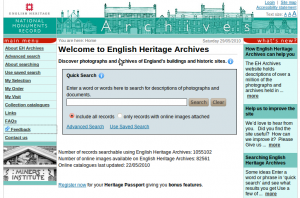
English Heritage Archives is a new website which allows you to search the catalogues of the National Monuments Record in Swindon, without having to visit.
There are basic and advanced search pages, the ability to save your searches, and individual records, and you can order copies of any archives. As with the normal Enquiry and Research Services, they’ll then send you photocopies of any photos relevant to your interests, and you can order better quality prints. The original service is still available for those who want to use it.
The site is part of the NMR’s group of websites such as ViewFinder (historic photos) and Heritage Explorer (educational material), and where an image is available on ViewFinder, you’ll see it in your search results on EH Archives.
The site went live at the start of April, so the team who put the site together need your feedback to help them improve it. They’re also interested in how useful it is, and which features are most used.
There’s a link in the left hand menu to their feedback survey, so if you’re a professional or amateur researcher have a play around and vent forth your opinions!
Disclosure: I work at the NMR, and helped co-ordinate the testing of the site. But don’t let that stop you telling me what you think in the comments! 🙂
Awards were given to Liverpool One, Sites 1 & 7, the Pier Head Canal Link (which I personally love, and which is some consolation for the Carbuncle Cup awarded to the Ferry Terminal last year) and the John Moores Art and Design Academy This means that three out of the five North West winners are from Merseyside.
A lot of the awards went to educational projects (including LJMU), and it’s been noted that this may be the last time education has such a chance as this. A moratorium on new school buildings has since been announced as part of the new government’s cost-cutting measures.
Landscapes get Lottery windfall
The Heritage Lottery have announced that they are giving grants of between £250,000 and £2m for ten countryside areas, known for their historic natural landscapes. The aim of the Landscape Partnerships programme is to encourage communities to become interested and involved in preserving their local heritage. While none of the areas nominated this week are urban (or, indeed, man-made), it seems to fit with the Conservative’s ideas of ‘Big Society’, and it may only be a matter of time before this kind of scheme spreads to other heritage areas such as our own World Heritage Site.
As part of the BBC’s History of the World project, they showed The Tale of Two Rival Cities. This is the story of Liverpool and Manchester, and how the two most important cities in the north-west vied for supremacy during the Industrial Revolution.
In reality they relied on one another: Liverpool was the gateway for the raw material for Manchester’s cotton manufacturing. It was a symbiosis, but Liverpool gentlemen overtaxed the Manchester men, leading to the construction of the Manchester Ship Canal to avoid Mersey tolls.
It’s a great programme, hosted by Stuart Maconie (from Wigan, halfway between the two cities) and covers everything from slavery and steam engines to gentrification and the trade unions. It’s available on the BBC iPlayer for a short while.
The Financial Times has a special report on its website entitled The Future of Cities. Although I haven’t had a chance to look much into it, it appears to be a huge resource on architecture, business, planning and the environment. If you want to read anything on current urban thinking, then this is probably a good place to start.
And finally: I’ve had to disable trackbacks and pingbacks. These are similar to comments, where a paragraph of your blog will appear below a post of mine if you mention it on your own site. And, like comments, they’re open to abuse by the less salubrious parts of the web. It’s one of the risks of blog-writing, I suppose, but let me take this opportunity to let you know that you can still comment! Please do – I’d love to know your own views on what I’ve written about!
Bootle village in 1851, from the Ordnance Survey 1st Edition
I’ve put the finishing touches to the History of Bootle page today (minus a couple of tweaks here and there). I’m planning on concentrating more on Historic Liverpool over the coming weeks, after being more involved in other projects over the past weeks.
So, if you know anything about Bootle, or there are other pages you want to see on the Historic Liverpool site, drop me a line or fill in the comments form!
Historic Liverpool is all about the historic landscape of Liverpool, rather than the history. So while there are thousands of merry men and women who’ve appeared in the annals of the city over the years, I’ll be concentrating on the built environment – how the city has changed over the years. So I’ll be most interested in comments about buildings – farms, offices, libraries, churches – and landscape features – lakes, ponds, forests, streams, dams – and things like roads and railways. If, of course, you know of great people who’ve shaped the city and its suburbs, and who deserve a place on the site, please do mention them in the comments – I won’t delete anything unless it’s spam!
Bootle’s one of the areas that’s changed the most – from a tiny village (albeit with its own waterworks) through being a seaside resort(!) to an industrial landscape and the modern area of Liverpool it is today.
I’ll be moving on to Childwall next, so if there’s something you’ve been dying to tell about that part of south Liverpool drop me an email or comment. Or if there’s some other part of Liverpool’s history you’d be more interested in finding out about, give me a shout and I’ll do that instead.
I look forward to hearing from you! (Don’t all shout at once…)
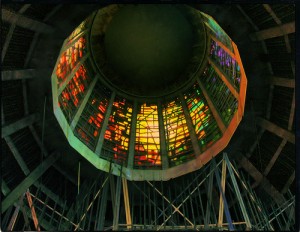
Liverpool Metropolitan RC Cathedral, by Jonathan Gill via Flickr
A new book is released this month by Stephen Bayley, and published by RIBA.
Liverpool: Shaping the City is a large and colourful exploration of the city’s built history. It includes development, old and new and brings in photographs from the early 20th Century when some of Merseyside’s most iconic buildings were being constructed.
We learn in the Foreword by RIBA’s president Ruth Reed that Liverpool can lay claim to three world firsts in architecture: the first building to use skyscraper technology (Oriel Chambers in Water Street), the first wet dock (no prizes for guessing) and the first hydraulic cargo-handling system.
Perhaps I’ll come back to a full review of this book once I’ve read it (it only arrived this morning!), but suffice to say it looks to include good coverage of how Liverpool has developed as a city, and how it does and will continue to change as the years progress.
Meanwhile, you can read a column in the Times by Stephen Bayley, How Liverpool returned from the dead which introduces some ideas from the book. His main point is that you can ‘design your way out of a depression’ by building cities which bring joy to people. From a personal point of view, I whole-heartedly agree (though my cynicism would reword it as ‘design yourself towards the end of a depression), which is why I – and others – get so animated when an ugly construction is plonked down in a beloved vista.
My favourite quote from the article, and one which almost single-handedly justifies this blog and my interests in Liverpool’s buildings, is “We make our environments and then our environments make us”. He suggests putting it on a T-shirt, and I just might.
Welcome back to the Liverpool Landscapes blog! I do hope you came checking every day while I was away ;-), but even if not, you’ll be glad to know I’m rested, relaxed and raring to go to bring you the most interesting bits of news concerning the history of Liverpool. The theme of this post seems to be milestones, in a way, so let’s start with politics…
The general election and history
The first occasion on the horizon is of course the General Election. As a civil servant, I should probably be careful what I say in the run up to May 6th, but it’s worth pointing out that the Museums Journal this month contains a short analysis of what the main parties intend to do should you vote them into power next month. (You’ll need to register to view the article, or pick up a copy of MJ in the local library).
All the parties seem to agree on free admissions to museums, a move away from targets, and on increasing access to arts and cultural institutions. However, Louise de Winter of the National Campaign for the Arts notes that Labour’s reliance on free admission to help with increased access is not enough.
The Conservatives emphasis on helping people to help themselves (“Big Society, Small Government”) may extend to the cultural sector, with an ‘arm’s length principle‘ being applied to supporting museums.
The Liberal Democrats also want to enable museums to be more independent and enterprising, and want to generate more arts and heritage money from the National Lottery through tax changes.
At the time of the Journal’s press, the Labour manifesto had not been released, but it noted that the party wanted to ensure all Britain benefits from the digital revolution, and to build on earlier schemes such as Find Your Talent.
English Heritage publish heritage protection paper
Even though the Heritage Protection Bill did not make it into the Queen’s Speech last year, work has continued on reforming the way the historic environment is cared for.
All you professional archaeologists out there will know about PPG15 and PPG16, the two documents which make rescue archaeology (and so the vast majority of professional archaeology occurring in this country) possible. These documents are both almost 20 years old, and have been replaced by Planning Policy Statement (PPS) 5.
The long term aims with heritage protection reform (HPR) are to replace the current system of listed buildings, scheduled monuments and other designations with a single, hierarchical system. This would make it easier to protect historic sites and buildings, as well as make it simpler for owners of such assets to find the information they need to effectively protect them.
The new document also covers such topics as approaches to planning, climate change issues, and the monitoring of the historic environment. It’s available to download from the Department for Communities and Local Government Planning for the Historic Environment page.
Well, those are probably the big stories of the day, but there are a few more tidbits to cover.
It’s International World Heritage Day tomorrow (18th April)! Now, I’m assuming that anyone reading this post is somehow interested in a certain World Heritage Site, and now’s your chance to raise awareness of where it is, and the work it takes to preserve and look after it.The Global Development Research Center (sic) has a few suggestions on what people can do to celebrate and commemorate.
Liverpool City Council have organised five tours of parts of the city which fit in with this year’s theme, which is the Heritage of Agriculture. Now, you may argue that Liverpool’s WHS has little to do with agriculture, but as the foremost port of the empire, merchants in Liverpool oversaw a huge proportion of the transport of the world’s agricultural produce. For details of the tours, download the leaflet from the Liverpool World Heritage web site. Places are limited, so get in early!
Speaking of mercantile heritage, the Old Dock is finally to be opened to the public on 4th May. As the BBC report, the remains of the dock wall were carefully preserved during the construction of Liverpool One, and can be seen through a window placed in the floor at the bottom of the steps from the Liverpool Wheel where the Liverpool Wheel used to stand [cheers for the correction, Adrian!].
From next month, there will be a “visitors’ facility” to allow you to view objects found during archaeological excavations there, a computer reconstruction fly-through, and the east section of the dock which has a tunnel suspected of linking to Liverpool Castle. More details are available on the Maritime Museum Liverpool web site.
And finally-finally, architects Baca have another masterplan to ruffle the feathers of the Liverpool Preservation Trust et al. This time the south docks are in the picture, and Baca want to “bring an interesting new approach to waterspace design that will unlock the potential of these wonderful docks and the World Heritage Site”.
As you know, I for one consider that the World Heritage Site needs its potential unlocking. It’s so… tied up there in those creaky old buildings.