
Skip to content

Posts from the ‘News’ Category

Historic Liverpool website complete

As you may or may not know, the Liverpool Landscapes blog is partner to the Historic Liverpool website. That website is now ‘complete‘.
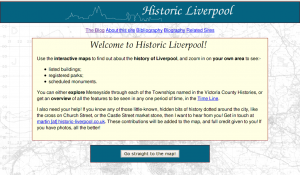
The Historic Liverpool websiteOf course, no website worth its salt is ever really complete, but you should be able to browse and read everything, and find a lot of interesting bits of history in your part of the city – or any part of the city! The main feature is the interactive map. Here you can begin to zoom in and pan around (and zoom out again!) and click on any of the dots on the map which interest you. There are also a couple of other things you can find on there, such as a rough outline history of the city of Liverpool as it developed from a backwater fishing village in the shadow of West Derby and Chester to a major port and settlement in its own right.

Of course, now that everything is tidily complete, the next thing I’m going to do is add bits piecemeal all over the place, so keep popping back and you’ll find more there to look at.

The most important thing now, though, is to ask for your help. Do you know any ‘secret’ or hidden bits of history dotted around Liverpool, or Merseyside in general? That’s going to be the focus of additions to the site. If you send me your suggestions, complete with a little description and location, then I’ll put a pin in the map so everyone can see it! Full credit will be given to you, of course! If you’ve got a photo I can use, all the better! All comments are gratefully received, at martin [at] historic-liverpool.co.uk.

Liverpool as blueprint for British culture capital

Although officially no longer the European Capital of Culture, Liverpool’s success in 2008 has led to it becoming the blueprint for an ongoing series of similar, British-based awards in the future. Culture Secretary Andy Burnham (a Blues fan, it has been noted) announced today that the new award would be presented every two years. Liverpool 08 mastermind Phil Redmond will be drafted in to lead a working party to explore the idea, which hopes to stimulate regeneration and investment in other parts of the country, in the way it did in Merseyside.

The impact of the Capital of Culture year will be debated at the University of Liverpool. Called Impacts 08, the event will be attended by Burnham and Redmond, and will discuss the effect of events like the Tall Ships Race and Paul McCartney’s concert Liverpool Sound, which brought in £5m. Along similar lines, Edwin Heathecote in the Financial Times examines the legacy of 2008 in terms of the built landscape, giving a fairly positive view of such developments as the Blue Coat chambers and the massive Liverpool One centre.

Finally, what English Heritage suspects is Britain’s first mosque is being regenerated, over 100 years after it fell out of use. It is hoped that this centre on Brougham Terrace, West Derby Street, will show the age of the roots of British Islam. The mosque was founded by and Englishman, Henry William Quilliam, who converted to Islam in 1887.

Independent – Britain’s first mosque to be reborn – after more than a century

BBC News – Revamp for England’s first mosque

A few more things for those of you who like your online resources:

English Heritage’s Heritage Explorer website includes a page on Liverpool as a case study for how to use their educational resources. The site concentrates on West Derby, and the project carried out by a Year 2 class to look at the historic environment around their school. The page includes a lesson plan, and some tips on how to get the kids studying. As well as this case study, the Heritage Explorer site is full of other historic resources for use in the classroom.

Another of English Heritage’s projects is featured on the Council for British Archaeology’s new website. The Aerofilms collection is a massive number of aerial shots of the whole of Britain, spanning nearly 100 years. Only a handful of images are currently available, including one of Liverpool’s old customs house and surrounding bomb devastation in 1946, but plans are afoot to get this amazing resource online in the future.

Also, for those interested in the archaeology hidden under Liverpool Bay, Wessex Archaeology are conducting a pilot scheme to investigate this body of water as part of their England’s Historic Seascapes research, in association with English Heritage. There’s a great summary of all the exciting stuff that should be found on the seabed on their site, and I’ll try to keep you up to date with their findings.

West Derby trams, new CBA website, and an end to 2008

The latest edition of the free Liverpool Link newsletter has a fairly long article about West Derby trams. Recently, roadworks on Mill Lane have revealed the old iron rails which the trams ran along – single lane with passing loops – and which were permanently visible until around 1970. Green trams (to Green Lane, of course!), and white first class trams ran along the route, until replaced soon after the last World War by motor bus services. Another still-visible reminder is a small junction box on the corner of the cottages leading to St. Mary’s Church. If I’d have read the article in time I would have tried to get a photo, but alas I was too slow before I had to leave Liverpool for New Year! If I find I’ve actually got one hidden on my computer somewhere, I’ll add it, but in the mean time go to West Derby village and have a look for it – it’s a reminder of a disappeared age!

For those of you interested in finding out more about history and archaeology on the Internet, the Council for British Archaeology has a new site (www.britarch.ac.uk), which has been launched for the 2009. As well as a more modern layout, the site gives you links to online resources such as the British and Irish Archaeological Bibliography (BIAB), and publications such as the Council’s own British Archaeology Magazine, as well as advice on how to get involved in archaeology, or keep up to date with archaeology in the news.

Finally, it is now 2009. Liverpool is no longer the European Capital of Culture. That accolade belongs to Vilnius in Lithuania and Linz in Austria. But Liverpudlians took this year’s celebrations to their hearts, took pride in the events, and took personally any attack on Liverpool deserving such an honour. Ringo will certainly remember that. But the greatest challenge has always been what comes after. Liverpool One is all but complete, although Zavvi didn’t survive to see its new shop in the development. The new Museum of Liverpool is rapidly taking shape. And numerous projects have sprung up or been given new lifeblood by the injection of money and interest in the city. I can’t help but think that all this momentum will be carried on by the city. Despite the huge numbers of tourists who came to Liverpool in 2008, many more will not have been able to make it, and will come next year, or the year after. Thousands more will have told their friends, who will make the trip in the not too distant future. As long as we’re here to welcome in the same way we’ve welcomed people throughout our thousand year history, Liverpool will always be the Capital of Culture.

Woodlands Remembered and Created

There is a very strong woodland feel to events in Liverpool this weekend.

Mab Lane in West Derby is being transformed by the planting of tens of thousands of new trees on a brownfield site, in order to create “the world’s most colourful woodland“. Work is expected to start in Spring next year, and will cost £700,000.

Also this weekend, Liverpool’s Pool Project are celebrating that which first brought royal attention to the area, and which is largely forgotten today: the royal hunting forest of Toxteth. The idea is to recreate one of King John’s hunts through 21st Century Toxteth, and at the same time gather information about the archaeology, biology and botany of the area bounded by modern Upper Parliament Street, Smithdown Road, Ullet Road and Sefton Street.

Toxteth Park was part of a large area of land on the north side of the Mersey which was popular with medieval royalty for hunting and riding. For hundreds of years it was ’emparked’, in practice meaning nothing could be built on it. Only when this status was removed did large scale building begin in the area. In its early days it was the preferred suburb for rich Liverpool merchants to escape the hustle and bustle of the city centre. In later years these richer inhabtants of the city moved to other areas such as Rodney Street, north Liverpool/Kirkdale and West Derby. Toxteth became covered in vast swathes of Victorian terraces, built to house the ever-expanding working classes who kept the factories and docks going.

For more information, see the Toxteth pages of the Historic Liverpool website.

A new final draft website

This blog is the companion to www.historic-liverpool.co.uk, a website about the history, growth and expansion of the city of Liverpool, and the surrounding area. That website has been in production for about four years, on and off, with too many false starts and rewrites for a sane man to handle. But now the bare bones of the site are there: all the links should work, you can find out a hell of a lot about the city and its suburbs, and it shouldn’t look too shoddy either.

Please visit and take a look around, and if you like what you see, or have any suggestions for how I should be developing this website, then please send me an email. Of course, if you’d like to encourage my love of Liverpool history, take a look at my Amazon Wish List!

‘On the Waterfront’ conference addresses heritage in a fading port

A conference currently taking place in Liverpool is the first of a series to look at the problems facing ports where heritage is often at odds with the needs of development in a city past its shipping heyday.

The three day event, On the Waterfront, sees speakers such as English Heritage’s Chief Exec Simon Thurley, as well as its former chairman Sir Neil Cossons, and Culture Company international director Sir Bob Scott.

Organiser Louise O’Brien stressed that “It’s not a conference about Liverpool“, and indeed future hosts of the conference include Shanghai, Lagos, Niagara, Gdansk, and next year’s hosts Marseilles. She is part of the Historic Environment of Liverpool project, a partnership between various Liverpool organisations and English Heritage which is coming to a close, and hopes to draw together the issues that have been discovered, and the common factors threatening the historic cores of world ports. O’Brien stresses that, although there have been a number of regeneration conferences this year, this is the first to put heritage at the core.

Today is the last day fo the conference.

Liverpool Buildings commended

The Bluecoat in Liverpool has been named one of the top 20 best heritage-led regeneration schemes.

Also, the Liverpool Architectural Society’s Design Awards have recognised the buildings in the city which have left their mark (in a positive way, of course!), although the Awards don’t cover the most recent buildings, such as those which make up Liverpool One. The shortlist can be viewed on the Liverpool Architecture Society website.

Changes to Liverpool Listed Buildings to mark International Slavery Remembrance Day

Saturday 23rd August was UNESCO day for the International Remembrance of the Slave Trade, and to mark the occasion Culture Minister Margaret Hodge has listed a number of buildings associated with the trade, and has amended the listing description of a number of others. In 2006, English Heritage started a project to review listed buildings and acknowledge historic links to transatlantic slavery and the abolitionist movement. For Liverpool, the changes to listed buildings are:-

Town Hall (Water Street, Liverpool) – includes an ornate frieze depicting slaves, animals (tigers, crocodiles, elephants) and other symbols of Africa. The listed buildings description has been amended to ensure that their connection to the slave trade is ‘adequately reflected’.

Allerton Hall (Springwood Avenue, Liverpool) – the former home of William Roscoe, and now a pub. The listed buildings description has been amended to ensure that their connection to the slave trade is ‘adequately reflected’.

62 Rodney Street (Liverpool) – Upgraded to Grade II*; owned by John Gladstone, father of William Ewart Gladstone, four times British Prime Minister. John Gladstone owned sugar plantations in the West Indies, and was an ardent anti-abolitionist. William Roscoe laid out Rodney Street itself, which survives remarkably well, with over 70 listed Georgian houses.

Mrs Hodge said: “These new listings and upgrades show the close and continuing historical and social links that much of our heritage has to the history of slavery both in this country and from around the world. It is particularly fitting that on this day of national commemoration, so many of our historic buildings and monuments are being granted a new or increased level of protection.”

For more information on English Heritage’s project, see its page on The Slave Trade and Abolition.

Formby dunes under threat

The Telegraph is reporting that the National Trust has identified the Formby dune landscape as one of ten threatened coastal features. Each piece of the coast so named will be significantly altered by the encroaching sea in the coming years, with sea levels expected to rise by up to 1.5 metres by 2100. The National Trust has given up hope of trying to protect them, and will let the sea and weather take its natural course over the coming decades.

The Formby sand dunes are part of a large scale landscape of Shirdley Sand which has been laid down by the wind since the last Ice Age. The coastal dunes spread from north Liverpool to Southport and beyond, and are only the most visible sandy features in a series which stretches inland in Sefton and Crosby, with some now-hidden dunes reaching up to 125m in height. The features are also havens for wildlife.

New Gilmoss community plan scrapped

The Liverpool Echo is reporting that a planned community for an area formerly occupied by Gilmoss has been scrapped. Originally the housing development was to include the involvement of Tesco’s, but in later years the supermarket giant pulled out and the new estate was to be housing only. The area was identified in 2006 as a ‘grot spot‘, and the final four roads were demolished earlier this year. Now David McClean have pulled out of the scheme to build 600 new houses, and the scheme lies in tatters.