Skip to content

Posts from the ‘News’ Category

New Map of Liverpool

OK, so I’ve already done a post today. But I want to show you this blog post about Stephen Walter’s map of Liverpool. This map is the product of a two year project, and Stephen visiting and falling in love in/with the city.

The most interesting thing about it from my point of view is that the map is geographically accurate, so potentially I could scan it in, geo-rectify it, and add it as a layer on Historic Liverpool. All I’d need is a really big scanner…

It’s on display at the Blue Coat hub. What do you think of it?

[UPDATED] Liverpool to get an observation wheel, and another in Liverpool One

St John's Tower

St John's Tower by tim.spillman via Flickr

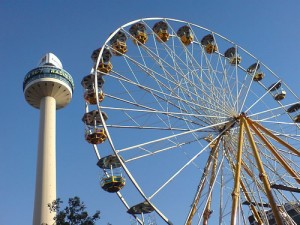
Update: The wheel in Liverpool One is now finished and taking passengers. The Echo article includes a video, and there are pricing details on Liverpool.com.

The Liverpool Echo is reporting on two proposed ferris wheel projects for Liverpool over the next 18 months. The first proposal was for an ‘observation wheel’, similar in concept to the London Eye, which would give a five minute ride lifting viewers high over the banks of the Mersey near the Echo Arena. This would be in place for about 12 months, and might be open for business as soon as next February. The second wheel seems to be more temporary, being sited in Liverpool One for the festive season. Both wheels hope to bring increased numbers of tourists to the city centre and across the Strand to the river front.

Ferris wheels are almost classic waterfront landscape features. In addition to the London Eye, Blackpool has a wheel on its Central Pier (built 1990), New Brighton had one as part of its fun fair, still in existence in the 1960s. Coney Island also has its Wonder Wheel.

So are Liverpool’s proposed wheels a great way to bring extra shoppers to the city centre in these straitened times? Or a me-too Liverpool Eye? Or a throwback to the seaside funfairs of old? How would this addition to the skyline measure up against the new museum and the Mann Island developments? Comment is free…

I saw three (or more) ships…

Mersey Ferry Snowdrop turning into Pier Head, by Boilerbill via Wikipedia

Mersey Ferry Snowdrop turning into Pier Head, by Boilerbill via Wikipedia

I’m currently doing a little bit of research for the River Mersey page on Historic Liverpool, and have come across a quite anoraky, but truly amazing site about shipping. It’s called ShipAIS, and is run by “A group of ShipPlotter enthusiasts”. The site, like my own I suppose, is based around a map tracking all the shipping (or as much as possible) in UK waters, from Orkney to the coast of mainland Europe. The site built up from one man experimenting with motion detecting photography from his own window, and now includes the AIS information (identification and callsign info broadcast over the radiowaves). The ships are plotted on the map, including a couple of tracks (I noticed a track for the Mersey ferry Royal Iris when I was on the site today).

My recommendation for readers of this blog would be to look at the map of the Mersey, then click on one of the ships you see in the port for a detailed view of that area. In many cases you get a small photo of the ship in question, and in all cases you get the name of the ship, its speed, type, tonnage and a couple of other details.

The site could do with a few more controls to zoom and pan round the map, but this is a fascinating insight into Liverpool’s current role as a port, and the national context in which it sits. I could quite happily while a way an hour or so each day just exploring the map, and the site as a whole clearly has Merseyside origins and a Mersey focus. Go and have a look!

The Mersey and its Banks – Regeneration

Liverpool Garden Festival by MC =), from Flickr

Liverpool Garden Festival by MC =), from Flickr

Two stories come together this week which conjure up memories of Liverpool in the 1980s (limited memories for me personally, as I was two when the Garden Festival was on!).

The Garden Festival site is finally beginning the last segment of its journey of regeneration. The company Langtree are the developers, who hope to begin work in November with the site being completed in a year. The £250 million redevelopment will include restoration of many of the gardens, and the building of homes. The BBC story seems to suggest that the site has been derelict for the 25 years since the Festival, which I would suggest cruelly overlooks Pleasure Island, scene of many an exciting Bank Holiday in the mid-1990s. 😉

The related story is that Lord Heseltine gave a speech yesterday to a conference celebrating 25 years of the Mersey Basin campaign, an effort to clean up the River Mersey. Lord Heseltine warned against resting on our laurels. The river is cleaner now than it has been since the Industrial Revolution, but this should be “the platform to leap forward, not the opportunity to congratulate ourselves on a job completed.”

Those who know their recent Liverpool history will be aware that Lord Heseltine was the initial force behind the 1984 Garden Festival, although the then ‘Minister for Merseyside’ was often criticised for ignoring the deeper problems of Liverpool, and settling for this rather ‘cosmetic’ and temporary fix. However, it has been pointed out that the festival raised the spirits of the region, and showed what a co-ordinated effort with the Merseyside Development Corporation could produce.

Of related interest is the fact that Otterspool Promenade on which the festival site stands was created from the dumping of household waste and debris from the Queensway tunnels from the 1930s, a process which clearly had some detrimental impact on the river, and meant that the natural features of Otterspool and Dingle Point were lost beneath the concrete which later capped the promenade.

It also goes to show that even recent history is constantly impacting on the landscape, shaping the city we live in! Feel free to share your Festival memories, or your views on the site in general!

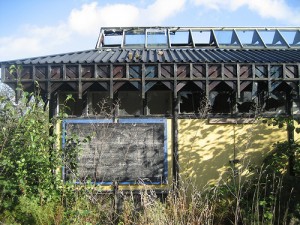
Note: The photo above is from a collection of photos of the derelict Garden Festival site by MC =) on Flickr. This is a great collection of photos, though tinged with a slight spookiness and desolation. Plus an abandoned typewriter. It’s full of Creative Commons goodness too, so have a look!

Secret Life of Smithdown Road

National Museums Liverpool are putting on an exhibition at the Oomoo cafe on Smithdown Road, showcasing the way in which the road has changed over the years, reports Art in Liverpool. The exhibition, which runs throughout September, will consist of photographs and stories – the memories of old and young who live and have lived in the area – to build a picture of Smithdown Road over time.

This is precisely the thing I’m trying to do with Historic Liverpool, and it just goes to show that there is an audience out there for this kind of history, this landscape archaeology of a single road! It’s incredibly important when writing about history in such a public arena that you connect with what the audience wants, and not what you want to tell them (unless you’re confident you have a new and interesting angle, of course!). That this exhibition actively involves the local residents is excellent; they are the main audience after all. It’s a shame I don’t think I’ll be able to make it, but hopefully I can learn something from this. I know my own site is quite one-sided at the moment (I’m trying the interesting angle, which hopefully isn’t covered by other similar sites), so in future I will try to add stuff more directly related to the people of Liverpool. After all, the aim of the site is to give you insight into the history of your area, help you explore and encourage you to get out there and see the place in a new light.

I’m still finalising the comments arrangements, but soon you’ll be able to hold forth on pretty much any page, so please do!

Historical notes: Smithdown, once known as Esmedune, was a manor mentioned in the Domesday Book, and was part of the royal forest of Toxteth, used for hunting.

Liverpool’s Award-winning Architecture

Terminal, by light_arted via Flickr

Terminal, by light_arted via Flickr

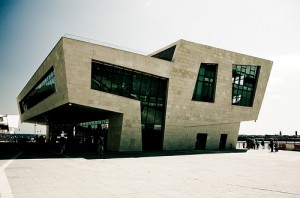
The Echo reports that Liverpool’s Pier Head ferry terminal has beaten off strong competition – including Liverpool’s own Grosvenor One Park West – to win the Carbuncle Cup, a prestigious acknowledgment by Building Design Magazine’s three judges of the terminal’s exceptional design. Unfortunately, of course, this award is for Britain’s ugliest new building.

Despite a Merseytravel spokesperson’s assertion that: “We are proud of the Pier Head Ferry Terminal and have received widespread support for the building from the community here on Merseyside,” a snap poll on the Liverpool Echo’s website suggests that three quarters of Scousers hate the thing.

Two of the problems facing the ‘carbuncle’ are the fact that it sits smack bang in front of the rightly-adored Three Graces, and in a World Heritage Site, and also that it looks like the new Liverpool Museum building’s wonky little brother.

Update: Two more articles talking about the ferry terminal buiding: straight from the horse’s mouth at Building Design Magazine, and analysis in the Daily Telegraph.

Liverpool sites get £3.3m funding, listed building to be auctioned, and history going missing

Update: The BBC has reported that the Main Bridewell was sold at auction for £450,000 to a developer. Though the article mentions that ‘In 2004 developers discussed turning the building into a luxury hotel’, I will be waiting with bated breath to see what they actually do.

One of those days when several interesting stories come along at once!

Lowlands, the Grade II listed merchants villa in Hayman’s Green, West Derby has just reopened following  a £1.2m restoration project. The villa was designed and constructed by Thomas Haigh (architect also of  Marks & Spencer’s building in Church Street) and was owned and occupied by a succession of wealthy merchants and  financiers. Vast areas of West Derby were occupied by similar men in the Victorian and Edwardian periods. The Inland Revenue occupied the buildings following war damage to the India Buildings on Dale Street in Liverpool city centre. Since 1957 it has been owned by  the West Derby Community Association, and in the 1960s was a centre for the emerging Merseybeat scene, witnessing performances by the Quarrymen, Herman’s Hermits and Billy J. Kramer in the basement Pillar  Club or the main hall upstairs. This history places it on similar ground to the Cashbar, the more  famous club and coffee house just along the road at number 8.

The Garden Festival site is a place filled with memories for generations of families who all descended on it over the space of five months in 1984 (I distinctly remember the Postman Pat exhibit being centre of my attention). After lying derelict for many years (with the exception of Pleasure Island which occupied the site in the 1990s) £2.1m has been released to allow the redevelopment of the site to  commence. The North West Development Agency have put up the cash which will see a project to restore  the Japanese and Chinese gardens and pagodas, as well as the streams, lakes and woodland which cover  the site, which will become another green area for the people of Liverpool. Owners Langtree maintain  their ambitions to build 1300 homes on the site, a plan which was approved after a public enquiry last  year. A further £1.6m is being sought from the North West European Regional Development Fund. No real  mention of Pleasure Island on the news sites though…

The Main Bridewell on Cheapside, just of Dale Street is going for auction and is expected to fetch up  to £500,000. It’s proximity to the magistrates court on Dale Street means it was used to house  defendants before trial, and was originally built in 1866 to hold petty criminals. The building closed  in 1999.

for more information on why the Bridewell was so named, see the Encyclopedia.com question on the Bridewell.

Finally, in a mysterious and disturbing story, original Victorian features are going missing from the  area of Kensington in west Liverpool. Cobbles, cast-iron railings and original street signs are  disappearing from the streets around Edinburgh and Leopold Roads, but no one (residents or the Council)  seem to know who is pulling up these features. Rumour has it that the items (including stone setts  taken from ships which used them as ballast on voyages from Turkey) are being sold on the black market.  Areas removed are being replaced with tarmac. Anyone with information is being asked to contact the  council.

Liverpool architecture under threat and under debate again

Liverpool One, by liquidindian, from Flickr

Liverpool One, by liquidindian, from Flickr

The Grade II Newsham Park Hospital building is under threat, reports the Echo, due to an increasing level of disrepair, and neglect on the part of the owners. Now councilor Steve Radford has stepped up to try to save the building, calling on the owners to take action. Comments on the Echo site reflect anger that the council is not doing enough, while also worrying that there is insufficient cash to do anything.

Newsham Park hospital began life as the Liverpool Seamen’s Orphan Institution, caring for the children of families lost at sea. The building was designed by Aigburth-born Sir Alfred Waterhouse, architect of Liverpool University’s Victoria Building and the latest Liverpool Royal Infirmiary building. The building was eventually used by the NHS, but closed in 1988 since when it has lain empty.

The building is not currently on English Heritage’s Buildings at Risk register.

In other architectural news, two buildings are up for an award seen as the antithesis of the prestigious RIBA award. The new Pier Head ferry terminal, and the Grosvenor’s Liverpool One (ironically shortlisted for the RIBA award) are up for the prize.

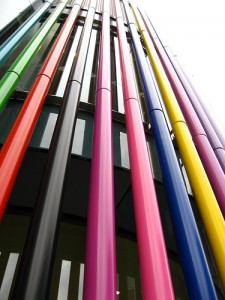
Although quirky, the new ferry terminal is not all that bad, especially as it’s such a small building (compared to, say, the new musuem). As with any new development, Liverpudlians are rightly protective of their Three Graces, and luckily people are coming to the defence of the terminal. I really admire the Liverpool One development (with perhaps the exception of the Lego flats to the north of Chevasse Park). The place is colourful, bright, and includes a green area which so many modern cities (Swindon, I’m looking at you!) lack.

What are your thoughts on the new development, and the awards?

75th Anniversary of Queensway Tunnel

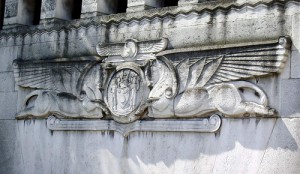
Coat of arms above the Queensway Tunnel, Liverpool. By Alli' Cat' (from Flickr)

Coat of arms above the Queensway Tunnel, Liverpool. By Alli' Cat' (from Flickr)

This weekend was the 75th anniversary of the opening of the Queensway Tunnel. The National Museums Liverpool blog has an article on the topic, along with links to several online resources, mainly photos. There are some great pictures of the tunnel being constructed, along with other construction schemes (the Anglican Cathedral and ships’ engines). These are from the Stuart Bale collection owned by National Museums Liverpool. In addition, there is the Queensway Mersey Tunnel album which is reproduced page by page (use the links on the right hand side to read each page). A highlight is the ‘mystery figure‘ who climbs up the side of a nearby building for a better view – being caught on camera in the process!

In other news, the Liverpool One scheme has been shortlisted for the Sterling Prize of the Royal Institute of British Architects (RIBA). The design won a regional RIBA award in May.

Vote for the International Slavery Museum in the The National Lottery Awards

International Slavery Museum .1, by andy_j_crowther (from Flickr)

International Slavery Museum .1, by andy_j_crowther (from Flickr)

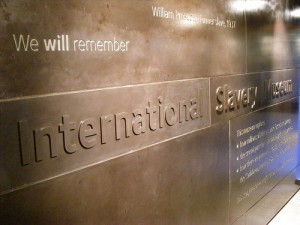
Liverpool’s International Slavery Museum has been shortlisted to win ‘Best Heritage Project’ in the National Lottery Awards along with ten other nominees. The Museum opened in 2007 and was funded by Lottery money. The museum is hugely important – it is the only museum which tells the whole story of slavery, including the continuing impact and legacy of slavery in the present day.

Voting is open until July 10th, so vote now! This is an amazing museum – I went there in 2007 shortly after it opened – so go along too, and show your support in person.