Skip to content

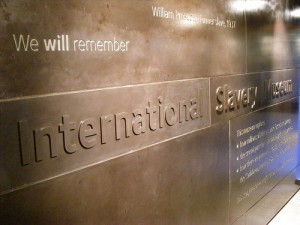
Vote for the International Slavery Museum in the The National Lottery Awards

International Slavery Museum .1, by andy_j_crowther (from Flickr)

International Slavery Museum .1, by andy_j_crowther (from Flickr)

Liverpool’s International Slavery Museum has been shortlisted to win ‘Best Heritage Project’ in the National Lottery Awards along with ten other nominees. The Museum opened in 2007 and was funded by Lottery money. The museum is hugely important – it is the only museum which tells the whole story of slavery, including the continuing impact and legacy of slavery in the present day.

Voting is open until July 10th, so vote now! This is an amazing museum – I went there in 2007 shortly after it opened – so go along too, and show your support in person.

Liverpool photographs on ViewFinder

The Homepage of the ViewFinder website from the NMR

The Homepage of the ViewFinder website from the NMR

I’ve known about this site for a while. OK, I admit it, I worked on the project myself for five months in 2007. But the ViewFinder website from the National Monuments Record is an amazing resource, where you can access around 80,000 images from the NMR’s collection for free. Try out the results for an Advanced Search for Liverpool. My favourites are the ‘merchant palaces’ of West Derby, mainly because that’s where I grew up!

Let me know what you think of the site!

www.viewfinder.english-heritage.org.uk

English Heritage launch Heritage at Risk, including Liverpool areas

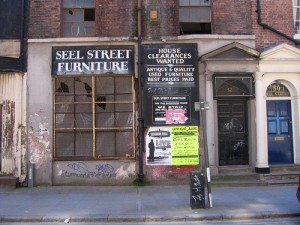
Seel Street Furniture, by Richard Carter (from Flickr)

Seel Street Furniture, by Richard Carter (from Flickr)

English Heritage launched its Heritage at Risk Register today, with wide coverage across the media. As I’ve mentioned before, Liverpool has nearly 40 Conservation Areas within its bounds, and it is these areas which come under most scrutiny in the media. The Seel Street Ropewalks in Liverpool and Birkenhead’s Hamilton Square make the list. Below are links to some of the articles on TV and in the papers:

The main thrust of EH’s report seems to be the problems of PVC windows and doors, unsightly satellite dishes and the loss of other original features of the suburbs. Though, of course, this is only the side deemed most relevant to the public, and there are many more pressing threats to the historic environment, such as dereliction, the declining economy, and uncontrolled development.

As you can see, the Daily Mail addresses the incredibly important issue of wheelie bins while others cherish their ‘tarnished jewels’. Closer to home the Wirral Globe mentions Hamilton Square. The ‘chairman’ of the Liverpool Preservation ‘Trust’ has another rant.

What are your views on the risks to your own historic environment?

Site Redesign, and Archaeological Illustration

Just a quick word to let you know that Historic Liverpool is undergoing a complete cosmetic redesign, as the home page was getting a bit bogged down, and also I visited the  final show for the Oxford Brookes/Swindon College MA in Archaeological Reconstruction, and was somewhat inspired (and unbelievably impressed!) by their work. I’ve not quite finished yet, but the new style will slowly percolate throughout the site in the coming days.

The timeline now occupies the right hand side of the homepage, with the two main interactive maps on the left. Hopefully this is a much cleaner design, and much easier to navigate. Let me know what you think!

A quick thank you to Jennie Anderson, who invited us to the show. Jennie’s website is, as you might expect from a web-leaning archaeological illustrator, a great example of attractive typography and layout, and full of fascinating archaeology too! Jennie’s MA has concentrated on interactive, Flash-based reconstruction, for such uses as visitor centres or even downloadable to your phone, to use while visiting the site. I’ll post a link here when I get one.

Access to Historic Liverpool data

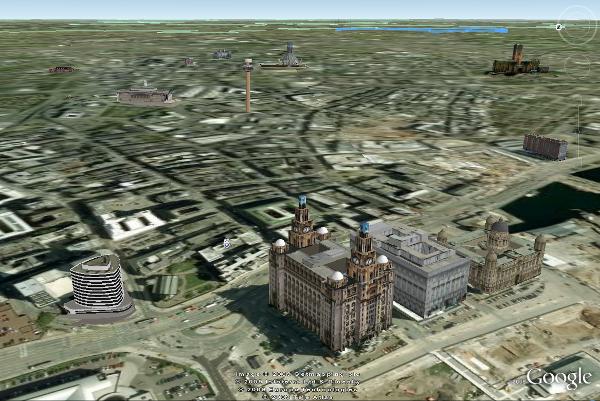
In the spirit of free exchange of data, I’ve been looking into methods of sharing the data which I produce as part of the Historic Liverpool website. Although still a relatively low number, I will be producing ESRI shapefiles which are used to power the maps. As the About this website page explains, the layers of Listed Buildings, Parks and Gardens, Scheduled Monuments and World Heritage Sites are from the NMR’s Data Download service, where you can get hold of the national data after signing up for an account. I can’t redistribute the NMR’s data, but I intend to post direct links to my own created layers in due course. There are many ways of doing this, but an important question is one of data formats. Which data formats can I be certain that people can use, for free? Well, I know shapefiles can be used in such free (as in open source) software as QGIS, but I’d like to be able to give out data which is viewable in Google Earth, as this is a popular, free (as in no cost) piece of software which provides background mapping, which are near-impossible to come across in the UK for sensible amounts of money. It would also be great to be able to integrate my data with fun stuff such as topography and 3D historic buildings, of which a handful from Liverpool are available on Google Earth.

Google Earth view of Liverpool Pier Head

Google Earth view of Liverpool Pier Head

At the moment I’m therefore looking for ways to convert shapefiles to KML files (which can also be viewed in Google Maps without the need to download extra software). There are several programs simply called ‘SHP2KML’ which claim to do the job. If anyone’s done this before, or knows a better way to do this, I’d be grateful to hear it. Otherwise I’ll be studying the manuals for the ever-useful FWTools command-line programs.

Finally, on the topic of online resources, Wolfram Alpha is a new “computational knowledge engine”. It works like a search engine, but instead of bringing back a series of web pages which probably contain your results, it tries to reply with the results themselves. This is best seen in demonstration, so try going to the site and typing “population of liverpool” and see what you get!

Site Update: New features

Having spent a lot of time working on Historic Liverpool, it’s been a while since I last blogged. There haven’t been a great many news stories to write about, but it’s time for an update on progress on the site.

Historic Liverpool

Historic Liverpool

There are two new sections on Historic Liverpool: the Liverpool Explorer, and Liverpool Landscapes (I hope this is confusing enough!).

Liverpool Explorer (archived) is an ongoing project – a map which will display all the features that you can get information on throughout the Historic Liverpool website. It’s quite sparse at the moment, with layers for Listed Buildings, Parks and Gardens etc (the same layers visible through the Townships page), and in addition two dots on the new ‘Hidden Gems’ layer. The Hidden Gems are those things you can see in Liverpool today, which don’t (at least yet) readily fit into any other map layers. At present these only include the Church Street Cross and Williamson’s Tunnels. In time these may move to other layers, and other features will be added to Hidden Gems. Either way, this is a bit of a novelty layer, and I hope it provides some idle browsing if nothing else!

Keep an eye on Liverpool Explorer, which will collect all the features available through the rest of the site.

Liverpool Landscapes is an effort to get back to my site’s original aims: to map the archaeological landscape(s) of Liverpool and Merseyside. Have a look at What Is Landscape Archaeology? for an explanation. Each Landscape in this section will address a cross-section of Liverpool’s archaeology from a landscape perspective: how do all the sites in the theme interconnect? Initially this will include period-based landscapes (Natural, Prehistoric, Medieval, Civil War) but will grow to include a number of others. Perhaps some will seem arbitrary to you: where do religious or sporting landscapes begin and end? You may have ideas for some that you think are more important than the ones I’ve included. Please get in touch, or comment below! These are as yet unfinished; new things will be added to them and the pages will be updated over time.

Whatever your thoughts on the site, get them down in the comments section and I will do my best to respond.

Conservation Areas at risk in Liverpool

English Heritage, as part of their Heritage at Risk campaign, recently launched Conservation Areas at Risk. This will begin with a census of all the conservation areas in the country, of which Liverpool has 34. EH are often under fire for their inaction (or indeed action) on initiatives such as this, so it will be an interesting one to watch.

English Heritage also wants your help with this, so if you live in a Conservation Area and feel there’s an issue with the “wrong type of development” (as EH chief Simon Thurley puts it) then go to www.english-heritage.org.uk/conservationareas.

Liverpool’s St John’s Centre delayed

A quick snippet of bad news: like many developments all over the country, the St. John’s Shopping Centre redevelopment has been delayed by three years, the Liverpool Echo is reporting. The demand for shops has fallen as the economy slows, although the owners of the site, Land Securities, are optimistic that the demand will reach “pre-recession levels” by 2012.

St John’s was built in 1969, redevelopment which followed extensive bomb damage suffered across Liverpool city centre during the Second World War.

Historic Liverpool on the Web

As things seem to be quiet on the ‘historic Liverpool’ front (that’s historic with a small ‘h’ – not my website!) I think it’s a good time to put down a few quick notes about where Historic Liverpool (the website!) and my interest in history on the web should be leading me in the next few weeks and months.

For those of you eager to see what additions will be made to the main site, I can tell you that I’m currently researching West Derby township. This includes the former villages of Tue Brook, West Derby, Knotty Ash and Broad Green, and will hopefully be online soon. Anyway, until then…

Every month new historical and archaeological resources go online (for example the Liverpool Wiki), and the ones that have been online for a while are constantly adding to their databases (see the Archaeology Data Service). Though the Council for British Archaeology’s website (recently relaunched) was a pioneer in making use of the web for archaeology, the historical and archaeological disciplines are only gradually making full use of the web, in particular “Web 2.0“, the interactive web. This new, user-generated form of the Internet is a big opportunity for history and archaeology, building on the participation seen in many amateur excavations in Britain for decades, and the discussion forums taking in Liverpool history amongst other city issues all over the Net.

It’s part of my job to know about what makes an attractive, usable, interesting heritage website, and I’d like to pass on what knowledge I can to help promote new archaeological and historical Web 2.0 sites. My own site, Historic Liverpool, shows my own modest efforts (more archaeology than Web 2.0!) but so much more sophisitcation is possible in this developing era that I really want to do what I can to help. With this in mind, I will shortly be launching a new website (to be named – watch this space!) dealing with [edit:] expanding this blog to include the wider developments in heritage on the web. There’ll also be a blog there, where I will put my thoughts down on the subject, along with longer articles on avoiding some of the pitfalls of building a complex or data-rich website aimed at the general public and interested amateur. After all, this is the advantage of the Internet, and the sharing of data and knowledge – anyone can become involved! Edit: for now I have little time to dedicate to a new website, so I’ll be mentioning interesting web initiatives on this blog until someone invents the 34 hour day and I have time to write two blogs!

Finally, while researching West Derby I read the relevant chapter in J.A. Picton’s Memorials of Liverpool, vol II, Topographical (1875). In it he details all the roads from Low Hill eastwards, and takes in Kensington, and Newsham Park. He rues the state of Wavertree Road:
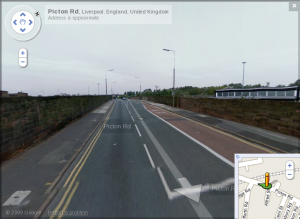
Picton Road as seen by the Google StreetView car

Picton Road as seen by the Google StreetView car

“at present a somewhat unsightly entrance into Liverpool … flanked with shops and dwellings of an inferior class. Down to 1830 this road was a beautiful avenue lined with tall trees on each side, whose umbrageous foliage meeting overhead, imparted a grand and solemn character to the vista. The construction of the railway crossing the road … and the subsequent construction of the bridge … made the first inroad”

This fairly judgementmental description of the area is typical of this wonderful book, but the modern mapreader must note that whereas in 1875 Wavertree Road stretched all the way to Wavertree (of course), these days the length from Picton’s bedevilled railway bridge to the clock tower is of course… Picton Road.

Another voice in the debate: is Liverpool changing for the better?

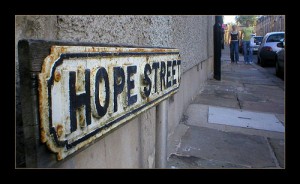
Hope Street

Hope Street, by SideLong (from Flickr)

We’ve seen how the debate is continuing over recent changes and development to Liverpool’s city centre. For a couple of years people worried that the centre was getting preferential treatment – and money – compared to the more needy suburbs. Now that change has swept across Chavasse Park and Hope Street, the moans are more concerned with how the old is being swept away to be replaced with the bland, average new. Today Ed Vulliamy comments in the Guardian how Hope Street, “one of Europe’s great boulevards, connecting the eccentrically massive gothic Anglican cathedral with the 1960s Catholic one” is being wrecked by new development. He also singles out the Maghull Group, and their ‘Hope Street Portfolio’. Personally, I find their slogan – “Invest. Develop. Construct.” – quite terrifying, along the lines of Veni. Vidi. Vici. And now we find that they bought part of the Liverpool College of Art complex from John Moores University, and are now renting it back to them, having not been able to do anything with the site in, as usual, these economic climes.

Check out the article, and let me know what you think. The Maghull Group have some awful practice behind them, and don’t take lightly to criticism.

Is Liverpool experiencing the ‘wrong type of change’? And what do you think of the Lime Street gateway? The buildings there were indeed an eyesore, but has Liverpool lost some hidden gems as the bookshops and greasy spoons of this world get moved on? Or are we freer now to admire some of the greatest Victorian architecture Europe has to offer? Are these little shops opening elsewhere? Comment is, after all, free.