Skip to content

Posts by Martin

7 ways in which Liverpool *is* the Museum of Liverpool

The ‘Museum of Liverpool‘ is a very fitting name, because this is a museum about the city, and about the people. It’s the largest national museum dedicated to a city in over a century, and opened in a year when the M Shed in Bristol, the Cardiff Story, and Glasgow’s Riverside Museum Project bring similar attractions to those places.

But just as the Museum of Liverpool will capture the city in a nutshell, the city beyond is a museum in itself. For starters, it contains objects that have survived from the past into a new use in the present, but unlike the museum, they’re not on here for display’s sake.

But, in a sense, Liverpool is the Museum of Liverpool:

Galleries

Anyone who’s studied the different areas of Liverpool to any extent – for its geography or its history – can’t fail to recognise the distinctiveness of each part of the city.

As different as a Roman gallery is to a History of Science gallery, so Toxteth has its terraces and its Victorian parks, West Derby has Croxteth Hall, Queens Drive and suburbia, Allerton its impressive large houses and the Calderstones, and Everton Rupert’s Tower.

To walk across the whole city (should you have the energy) is to take in all aspects of Merseyside history, from its prehistoric origins, through its political development to its cultural successes.

Cases

As with all museums of great age, Liverpool has its dusty containers of life gone by. Its preserved relics too delicate to handle directly, artefacts at risk in the race to the modern, interactive, disposable age.

Visitors

The museum, and the city, are not just for the locals.

Millions flock to Liverpool each year to sample the culture, history, sport and music, or pass through as travellers on their way somewhere else. What do these people see, feel and experience when they visit the city-as-museum?

The museum can only give them a glimpse of the full story, and so too the city itself can only show a side of Liverpool through the eyes of the visitor. It depends what they’re here for, and is coloured (for good or ill) by their preconceptions and experiences.

When they walk/fly/drive through the doors of the city-as-museum, will they head straight for the Beatles Experience gallery, the Liverpool One gallery or the Cathedrals gallery?

Or will they be given a guided tour by a local? Because of course, every museum needs…

Curators

These are the natives of the museum. They see much more than the visitors (though how much of the total might even surprise them). They know the shortcuts, the closed-off rooms, the main attractions and the hidden history.

When creating the galleries (through living in the city), they will be taking a selection of the whole and putting it on display for the consumption of the customer. They will try to show off the best of their corner of the museum, and show just how much they know of the great city.

Not everyone who arrives here will get to meet one, but those who do will get a great deal more out of their visit than those who do not.

Objects on display, and objects behind the scenes

It’s easy to feel like you know the whole of Liverpool. You can wander the streets for years, compete on its playing fields, drink in its bars, play in its parks and worship in its churches for every year of your life. But for every Scouse artefact you see, thousands are hidden from view.

Just as Merseyside’s museums have vast stores which the public never get to see, so the city has its secrets, its behind-the-scenes. There are the underground tunnels of Merseyrail and the river tunnels. There are rooms behind net curtains, and there are air conditioning systems and prison cells and private vistas that only a few see.

Old but new

The museum is a living, evolving part of the community, and similarly it has long been realised that the city is not a fossil, a finished piece.

A museum has to adapt to changing tastes, and must update itself to include new histories and interpretations. So a city must continually reinvent itself to move with the times.

A city (and a museum) is always trying to do this. Sometimes this is a popular success and sometimes not. Either way, neither museum nor city can stay still.

Participation

These days a visitor is not just a visitor. They’re a consumer of history, and a participant. Liverpool the city is heavily defined by  those who come to see it, as well as those who end up staying longer.

So whether it’s the World Museum’s hands-on events, or the city’s incomers shaping its very landscape and history, the city-as-museum is not merely built by the people who are already here, but a mixture of newer and more established contributions.

Liverpool as Museum

Liverpool is a city in the 21st century, but it is – and will continue to be – shaped by its past. The streets tell the story of its origins; it’s people the ways of its present.

Its galleries are full of the accumulated debris of 8000 years of use.

As viewers of its exhibits, consumers of its presentation and participants in its events, if we keep an eye open on our ramblings around its edifice we will be rewarded with a greater appreciation of the things left by our predecessors in these corridors of life.

And when we’ve explored all that the exhibitions and exhibitionists have to show us, there’s just time left for a browse in the bookshop followed by a big slice of cake in the café.

What’s your role in the Museum that is Liverpool? Are you a curator? A visitor? A guide? An exhibit? 🙂

Image: Monument to Edward VII, Liverpool, by mira66 via Flickr (CC-by)

Recommended Reading
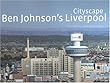
Ben Johnson’s famous Cityscape painting will be on display in the new Museum of Liverpool. The painting is a painstaking illustration of Liverpool – a bird’s eye view from above the River Mersey, and is available in paperback from Amazon. Click on the cover on the left to order.

Museum of Liverpool in the news

Toxteth – redressing the balance

July 2011 marked 30 years since the violence in Toxteth which would hang a cloud over the suburb of Liverpool for decades, at least in the eyes of the public at large.

It came to symbolise the economic problems of early 1980s Liverpool, and helped cement the stereotype of inner city, unemployed Scousers which probably lingers in some circles today.

Local press paid a lot of attention to the anniversary, quite rightly, but whenever the name Toxteth is mentioned (in these circumstances or elsewhere) it conjures up little else for the majority of people. I remember the first time I was old enough to find that the phrase ‘Toxteth Park’ was one that didn’t quite fit with what I thought the area was all about.

So I hope this little article and the accompanying longer page on the History of Toxteth can redress the balance, and put Toxteth’s situation in 1981 into some historic context.

Toxteth Park

Toxteth Park entered history as a pair of medieval manors – Toxteth and Smeedun (Smithdown). Around the time of the Norman Conquest these became part of the large West Derby royal hunting forest, including Simonswood and Croxteth Park in its bounds.

Toxteth Park remained a walled royal park for hundreds of years after this, only being developed for agriculture and later houses and industries when it was dis-parked by James I in 1591.

New Liverpool

Once dis-parked, Toxteth was quickly converted to pasture for animals, and later the richer merchant classes turned it into one of the first fashionable suburbs. Large houses were the first to be built on the land, and these can still be seen surrounding the Victorian Parks of Sefton and Princes.

Terraces

As with all of the early suburbs, economic development soon turned the area into a landscape of industrial units and housing, created by the southern docklands, warehouses and workers homes. This was one of the fastest transformations of inner Liverpool, with thousands of terraces and back-to-backs spreading across the landscape from the river to Edge Hill.

It was part of the engine house of Liverpool’s Victorian heyday, but it also sowed the seeds for its decline over the next 100 years.

Modernity

With the decline in the docks in the twentieth century, Toxteth suffered more than many. It’s population were so tightly tied to the waterfront industries and commerce that mass unemployment was the inevitable side effect when the focus of Britain’s trade shifted from the west to the south coast ports after the World Wars.

Post-war slum clearance also took its toll, ripping the heart out of communities and shipping them out to satellite estates like Cantril Farm and Kirkby.

The process continued through the decades, coming to a low point at the end of the 1970s. By 1981, relations between the local population and the police were at a low. The arrest of Leroy Alphonse Cooper under the despised ‘sus laws‘ was the spark which lit the dry kindling.

The Toxteth Riots were national news, and took place in the context of similar unrest in Brixton and Moss Side. Whether the government were already moving into action or not, the 1980s saw some reinvestment in Liverpool.

The Albert Dock scheme was part of this, as of course was the Liverpool Garden Festival. Whether this directly helped Toxteth is a topic for discussion, but a slow and steady trend can be seen through the creation of the Merseyside Development Corporation in the early 80s, through successive waves of development and the gradual renewal of Toxteth in the 90s and 2000s.

So when we remember the riots, remember also the long history of Toxteth as a forest, a park, a suburb, a bustling industrial sea of terraces before the problems began. See how Toxteth’s history is intimately bound up with how the riot came about. And see the process of regeneration which began slowly in the late 20th century, and carries on into the 21st.

Further reading on Toxteth

If you’re interested in the full history of the township of Toxteth, head for the History of Toxteth article on Historic Liverpool.

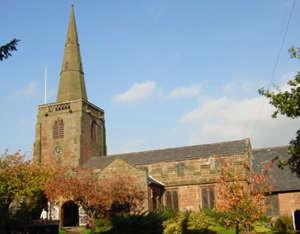
Image credit: St. James’s Church, Toxteth, by SPDP via Flickr.

Liverpool Heroes 4: Jesse Hartley

Continuing our look at the men and women who have had the greatest impact on the Liverpool landscape, this time we examine the work of Jesse Hartley, dock engineer.

Jesse Hartley (1780-1860) is best known as the architect of the Albert Dock. But this was just one of his achievements as Civil Engineer and Superintendent of the Concerns of the Dock Estate in Liverpool from 1824 to 1860, and his career was one which changed the face of Liverpool. It’s a landscape we can still see today, and his buildings continue to affect how we move through and how we deal with the built environment of the city.

Jesse Hartley was born in Pontefract, Yorkshire, and trained first as a mason. Although he later expanded his skills into engineering and architecture, this was to influence his building style for the rest of his life.

His approach to architecture was almost scientific. Contracted to build ‘new warehouses on the south side of the Salthouse Dock’ he first built models at the Trentham Street Dockyard nearby to test his designs. He closely specified the quality of bricks which were to be used, established his own stone quarry in Kirkmabreck, Scotland, and built the Oak, a coaster to bring the stone from this quarry to Liverpool.

Albert Dock

The Albert Dock is Hartley’s most famous legacy, and displays some of his revolutionary ideas. Among his breakthroughs was the use of sheet metal below the timber floorboards. This design which could withstand fire for 40 minutes unchecked, and was influential in future developments of the dock estate, as well as fireproof mills throughout Lancashire.

The dock was one of the first in the world to have warehouses right at the waters edge. Dock gates kept the water at a constant level whatever the tide, allowing ships to berth at high tide, unload straight into the warehouse, and leave as soon as the water level in the river allowed.

In addition, the Albert Dock warehouses were ‘bonded’ warehouses, which meant that customs dues were not paid when cargo moved from between boat to quay. Instead they were paid when stock was moved out of the warehouse, so further decreasing the time a ship needed to wait in port.

Unloading ships into the Albert Dock was a streamlined affair.

Docks, Canals, Railways and more

Although Hartley is best remembered for the Albert Dock, there are dozens of buildings along the waterfront built to his designs, and which display his signature style and attention to detail:

Many of these buildings show Hartley’s signature ‘cyclopean’ architecture. This involves using massive pieces of stone as the bulk of the wall, with smaller stones hand-shaped to precisely fill the rest (see links above). The colossal boundary wall seen all the way down Regent Road was also Hartley’s idea – in this case to reduce theft.

Hartley also designed a dock-wide railway system, to transport goods around and also to help in the building of new docks. He designed improved gates and locks at the Liverpool end of the Leeds-Liverpool Canal. He also designed lighthouses, chain pumps, mills and beam engines. He was a true multi-skilled engineer.

Jesse Hartley in the landscape

Some food for thought:

  • The docks at Liverpool grew from 46 to 212 acres (19 to 86 ha) during his time as Superintendent;
  • He worked on every dock that was in existence during his life (in addition to the ones he built);
  • He added 10 miles of quayside to the dock estate;
  • When the City Council attempted to demolish the Albert Dock after Blitz damage they found that, due to the solidity of the place, the job would have been too expensive and lengthy. They decided to leave it in place – to be restored decades later.
Albert Dock Blitz Damage

So not only did he change the face of Liverpool; his works continued to influence the shape of the city’s regeneration in the 1980s, and arguably into the new millennium.

Would there have been enough foot traffic at the Pier Head to warrant the Echo Arena, the new Liverpool Museum or the Leeds-Liverpool Canal extension not Hartley’s monumental architecture given a canvas on which to paint the revival of the city? Would Liverpool One have been possible (or even necessary) without the docks to act as a second centre of gravity in the city centre? Hartley’s contributions mean we can never forget our port heritage.

Of course, it’s possible to see the opposite as true: the Albert Dock is no aesthetic masterpiece. Had Liverpool managed to break free of the weight of the docklands perhaps the focus of attention would not have been split between the river-front at one end and St. John’s Market at the other (and London Road beyond).

But whether you see him as a boon to Liverpool’s past, present and future, or a historical albatross around the neck of Liverpool, preventing coherent regeneration (or both), there’s no doubt that Jesse Hartley changed the face of the city he found. He left an architectural legacy that still shapes the way we feel as a port town, and the discussions about how we shape the Liverpool of tomorrow.

Further reading on Jesse Hartley

A lot of the information in this post (where not otherwise linked) came from Nancy Ritchie-Noakes short but excellent book Jesse Hartley: Dock Engineer to the Port of Liverpool 1824-60 (Merseyside County Council/Merseyside County Museums, 1980)

Image:jesse hartley‘ by lizjones112, released under a Creative Commons Attribution license.

Liverpool’s historic architecture: tours, sell-offs and exhibitions

Well, now that Historic Liverpool is up, running and generally settling into its new clothes, we can get back to talking about the rest of the news! RIBA are planning tours of Liverpool, the City Council is planning to sell its historic buildings, and SevenStreets show you the best of RIBA’s upcoming Northwest Architecture Festival. Read more

Another new Historic Liverpool

I’ve been very excited about this for a little while, and though it may be just me who thinks this is cool, I’m pleased to announce the launch of the all-new, polished-and-improved, shiny-swishy Historic Liverpool!

And that’s why I’ve been neglecting this blog for several weeks now. Read more

Medieval church of All Saint’s, Childwall, to get new extension

Proposals for new developments at Childwall’s All Saint’s church look set to get planning permission. The plans are labelled ‘controversial’ by the Liverpool Echo.

All Saint’s is Liverpool’s oldest surviving church – parts date to the Medieval period – although the only parts of the building which will be knocked through are more modern sections of wall. In addition to this around 180 bodies may need to be exhumed and moved to the  Bloodstained Acre, land to the north never before built upon. Read more

Merseyside Archaeology Service closes

The Merseyside Archaeological Service (MAS) has been shut down, and now there is no longer access to the Merseyside Historic Environment Record. According to the notice on the Liverpool Museums website this was due to the removal of funding by all partners.

The MAS was set up in 1991, and received funding from the five Merseyside local authorities (Liverpool, Wirral, Sefton, Knowsley and St Helens). Historic Environment Records (HERs) grew out of the Sites and Monuments Records which began with Oxfordshire in the 1960s to cover the whole country by the 1980s. The change in name came in the last decade to reflect the increase in coverage and scope. Read more

Liverpool Heroes 3: Vikings in Liverpool

OK, so perhaps the Norse Vikings are aren’t the first people to come to mind when we think of ‘Liverpool Heroes’. They’re distant in time, left little visible trace in our city, and went about changing society through the delicate application of pointy-horned helmets.

But of course none of that is strictly true. There are traces of the Norse presence on our doorstep, and may have paved the way for Liverpool itself to be settled half a millennium after they first arrived.

Place names – Norse Language in Liverpool

The most obvious clues to the way in which Norse settlers changed the landscape are the place names seen across the county. In fact, the distribution is the very thing which gives greatest evidence to the local historian.

In the west of the region are the village and town names of Scandinavian origin: Toxteth, West Derby, Kirkby (and West Kirkby). In the north and east are names which signal the presence of Anglo-Saxons: Walton, Bootle, Childwall. These names contain elements of the language the inhabitants spoke (e.g. botl = Old English, “dwelling place”; kirk = Norse, “church”), and therefore must date from the time the Norse arrived from Scandinavia via Dublin, and began moving into Anglo-Saxon territory.

Norse Politics and Merseyside Geography

In addition to the language, place names reveal elements of the geographical or political situation of the time.

Raby on the Wirral, and Roby near Huyton, get their name from the Norse for ‘boundary settlement’. Where these villages stand was once the edge of a land division, probably between the Norse and the Anglo-Saxons (one of whose centres was Chester, to the south east of Viking Wirral and indeed Raby).

Other place names show that Norse settlements were on sand dunes or mosses (‘Meols’ is from the Norse ‘melr’, meaning “sandhill”. Rather than the ruthless invaders we imagine them to be, for a time they were confined to the less fertile ground on the edges of the land.

Thingwall – both on the Wirral and the Hall of that name south of Knotty Ash – signal the site of ‘Things‘, Norse parliaments. Not only does this show how Vikings settled and set up rather civilised government structures, it also shows how a common name on modern Merseyside owes its origins to something brought in by the Scandinavian incomers.

West Derby (Norse: “park with deer”) became an important administrative centre at this time, being the centre of the West Derby Hundred, which stretched from the Mersey to the Ribble at Preston. The medieval ‘wapentake’ court was held here, a castle was built shortly after the Norman Conquest, and West Derby’s importance to government lasted until the 14th or 15th centuries when Liverpool itself rose to prominence.

Vikings – Liverpool Heroes?

By the time their culture disappeared beneath the incoming wave of William the Conqueror’s army, the Vikings had made an imprint in the geography and history of Liverpool and Merseyside.

Place names which survive right up to today tell us where their churches were, their parliament and their borders, and they also tell us the type of landscape they occupied. But was the effect of these invaders on the Liverpool landscape ‘radical’?

They arrived, settled and established a court at West Derby, and for around 500 years this inland location was the centre of power in north west England. Later, Edward the Confessor saw fit to site a hunting lodge here, and later still William the Conqueror deemed it a worthy reward to Roger de Poitou, one of his most powerful allies in the invasion.

If it wasn’t for the society which grew up here around the Thing from the 8th Century, West Derby may have remained a tiny woodland village, and perhaps the attention of King John would not have so naturally fell on the Mersey for a place to launch his Irish campaigns.

Who knows what Liverpool would have looked like had the Vikings not settled on and spread from the Wirral all those centuries ago?

Further reading on the Vikings

Cover of the book Viking Mersey, by Stephen Harding

A great overview of the Vikings on Merseyside is Viking Mersey by Stephen Harding, and details of the West Derby Hundred can be found in History of West Derby by J.G. Cooper and A.D. Power.

Liverpool Industrial Heritage at Risk

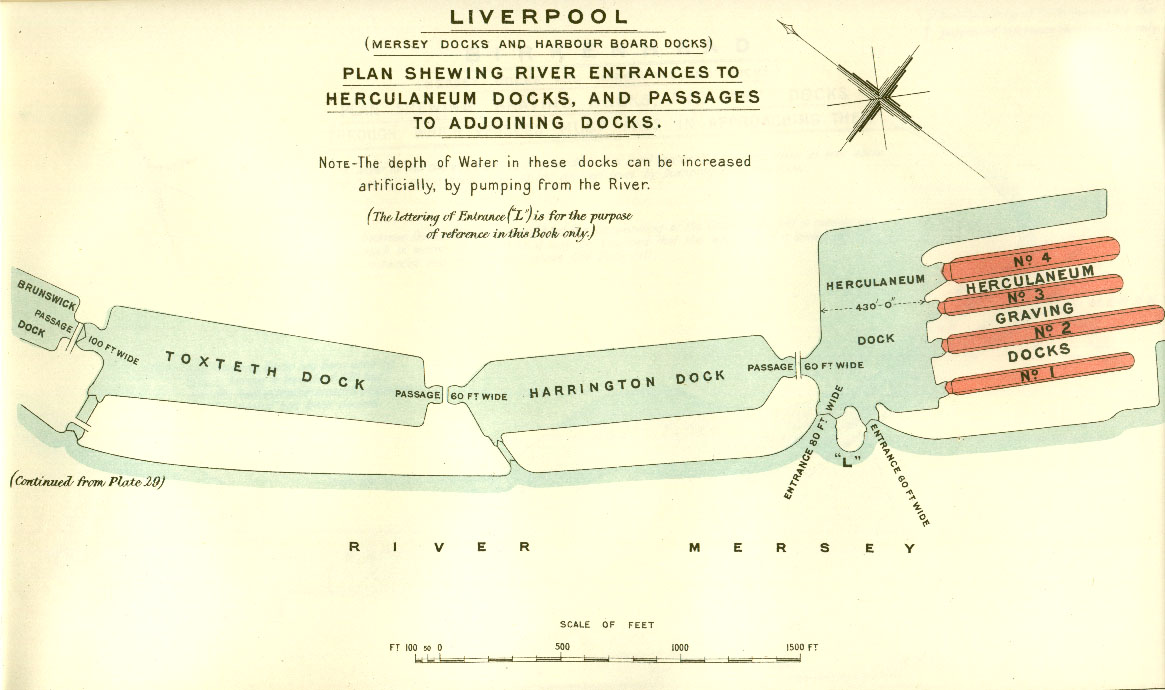
Plan of the Herculaneum Docks, South Liverpool, from the World War I Document Archive

The Herculaneum Docks, South Liverpool - industrial heritage no longer with us (from the World War I Document Archive)

Industrial Heritage at Risk is this year’s Heritage at Risk theme, launched today by English Heritage in conjunction with the Council for British Archaeology (CBA) and the Association for Industrial Archaeology (AIA). The annual Heritage at Risk survey launch is in October.

Liverpool is not always closely associated with ‘industry’ in the same sense as the wool industry of Manchester and Lancashire, or the coal industry of Yorkshire. Liverpool’s World Heritage Site is the ‘Maritime Mercantile City‘, and even though the Exchange buildings and the Customs house are closely linked with industry on a wider scale, it’s more accurate to class it as ‘commerce’.

However, commerce is difficult to see embodied in archaeology or buildings, and the buildings English Heritage are talking about are as often as not a product of industry, made possible by the Industrial Revolution, rather than playing a part in industrial production itself.

In fact, much of Liverpool’s built heritage fits this bill rather well.

[There is a lot more detail about the development of Liverpool’s small-scale industries (potteries, mills and the like) in the Liverpool and Toxteth sections of the Historic Liverpool website (or search for ‘mill‘ or ‘pottery‘ to see a whole lot more).]

Liverpool’s industrial heritage at risk

All the sites at risk in Merseyside can be seen via a search on English Heritage’s Heritage at Risk microsite: . You can then break the list down into classes of ‘at risk’ heritage, including buildings, conservation areas, scheduled monuments and registered parks and gardens.

The industrial class of heritage is small but easy to spot: there’s the infamous case of the Stanley Dock tobacco warehouse as well as the Stanley Dock conservation area itself.

But English Heritage wants a wider debate on this, rather than just promoting the current list of at-risk buildings. So, start here if you want (in the comments!) or visit the Industrial Heritage at Risk Flickr group.

Alarmingly there’s a photo of Albert Dock in the photo pool, but as I say this discussion is about a wider appreciation of industrial heritage. Remember, the Albert Dock was once indeed at risk of demolition, and is one of the best reminders of how historic buildings can be brought back into use successfully as modern developments.

The aim of the Flickr group is to bring people together to discuss which parts of their industrial heritage are most-loved, and those which perhaps should be added to the list come October. You can, as with any Flickr group, add photos and comments of your own.

So this is a call from one Liverpool historian to others: get your photos on there and promote the best of Liverpool industrial archaeology! Here’s a few suggestions to get you thinking:

  • Albert dock (you can never have too much Albert Dock)
  • Stanley Dock and the tobacco warehouse
  • Liverpool Maritime Mercantil City World Heritage Site (plenty of room for discussion)
  • Lime Street Station and the railway and tunnels to Edge Hill and beyond
  • Former Bryant and May Match Factory
  • The Three Graces
  • Leeds-Liverpool Canal

Liverpool Heroes 2: Kitty Wilkinson

Kitty Wilkinson’s story is classic Victorian Liverpool: born in Londonderry in 1786, Wilkinson moved to Liverpool with her parents when she was just 8 years old. Tragically her father and sister were drowned at the end of the crossing when their ferry hit the Hoyle Bank.

(This article was originally inspired by International Womens’ Day, which takes places on March 8th each year).

Despite being faced with the terrible hardships of the time, she was known for opening her house to anyone who needed help. One of the services this entrepreneurial woman took on was to allow people to use her house and yard to wash their clothes for a penny a time. During a cholera outbreak in 1832 she offered her scullery boiler to all who wished to wash their clothes and linen.

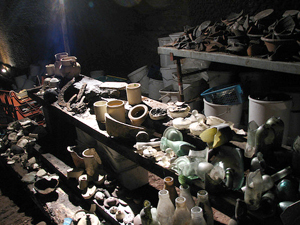
Photograph of the interior of Frederick Street wash house
Interior of Frederick Street wash house, built in 1842

This proved so popular that her cellar gradually evolved into a wash house. None of those who worked here became infected by cholera, so effective were her disinfection efforts (e.g. the use of bleach to help clean clothes), and Kitty’s efforts led directly to the opening of the first public wash house. This was in Upper Frederick Street, and opened in 1842.

Given support by the District Provident Society and William Rathbone, Wilkinson was made superintendent of bath, and through the newspapers was crowned ‘Saint of the Slums’.

In 2010 it was announced that a statue was to be erected in her honour, and would be placed in St Georges Hall. As councillor Flo Clucas, who campaigned for the statue, said: “Through rising from abject poverty to achieve lasting reforms in public health Kitty Wilkinson is a real inspiration for every woman in this city.”

So how did Kitty Wilkinson shape the landscape? She pioneered the public wash house movement, and the last wash house closed only around a decade ago. The Upper Frederick Street building was a monument to her efforts, and in a sense the rest of the wash houses were also. In less concrete terms she also affected the human landscape of Liverpool. For the first time there was a place to go to clean your clothes properly, and the effects on stemming the spread of disease through the city are a legacy of Kitty Wilkinson’s generosity and hard work. This woman was a testament to fact that even those born into the poorest levels of society can make a massive difference to the built and experienced landscape.

Further reading on Kitty Wilkinson

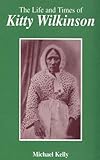
Cover of the book The Life and Times of Kitty Wilkinson, by Michael Kelly
Cover of the book Clean: An Unsanitised History of Washing, by Katherine Ashenburg

For a detailed look at the achievements of Kitty Wilkinson, see Michael Kelly’s 2007 book The Life and Times of Kitty Wilkinson.

For an overview of the history of personal hygiene read Clean: An Unsanitised History of Washing by Katherine Ashenburg.