Skip to content

Posts by Martin

Criticism for Liverpool regeneration plans, and new blog on Liverpool’s lost historic buildings

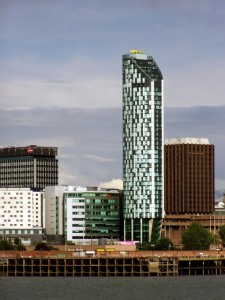
Photo of West Tower, Brook Street Liverpool, as viewed from the Seacombe promenade

West Tower, Brook Street, Liverpool, by E Pollock via Geograph

We’ve moved a step closer to Peel’s vision of ‘Liverpool Waters’ with funding being secured for the 54 storey Richmond Properties/Y1 tower towards the north docks, at the junction of the Strand and Leeds Street. It’s 25m taller than the current tallest tower, Tower West, but has been redesigned (again) after a failed attempt at getting planning permission in 2007.

Having failed to get the sleek design past the Council planning committee, it seems that the architects have thrown a bucket of Sticklebricks at the south side, to see what sticks (check out the third pic in the slideshow via the link above). Comments in the Architect’s Journal include the terms ‘pig ugly’, ‘hubris’ and ‘shoebox’ (though the third of these is a Wayne Colquhoun comment, so pinches of salt all round).

CABE criticise Pathfinder scheme

Further criticism for Liverpool’s attempts at regeneration come from Colquhoun’s arch enemies, the Commission for Architecture and the Built Environment (CABE). The commission has hit out at the New Heartlands Housing Market Renewal scheme, particularly parking courts and the quality of housing. SAVE’s Will Palin added to the judgment, claiming that “swathes of good Victorian terraced housing been emptied and left to rot”, to be replaced by inferior buildings.

New Pictorial History of Liverpool

OK, enough about planning for now. Adrian McEwen (via Twitter) pointed out the new Streets of Liverpool website.

This blog brings you views of Liverpool from across the 19th and 20th Centuries, with a paragraph or two about what you can see in the photos. The February 8th post is all about Lost Churches of Liverpool, which is a kind of post-script to the 2001 book The Churches of Liverpool by David Lewis, which was published by the blog author.

It’s great to see some little admissions of what the publisher would have liked to have done better in the book (an index, for example), but to make up for this (perhaps!) future blog posts will give us photos of the greatest losses to the city, starting with St George’s Church, which stood where Liverpool Castle once was, and where now we find the Victoria Monument.

The most recent post as of this writing does a similar service to other lost Liverpool buildings, including arguably the most-missed: the Customs House, which was needlessly demolished in the post-Blitz redevelopment.

Make sure you keep an eye on this new blog – it promises to be a good one!

Maps for Local History Research (part 1: Modern Maps)

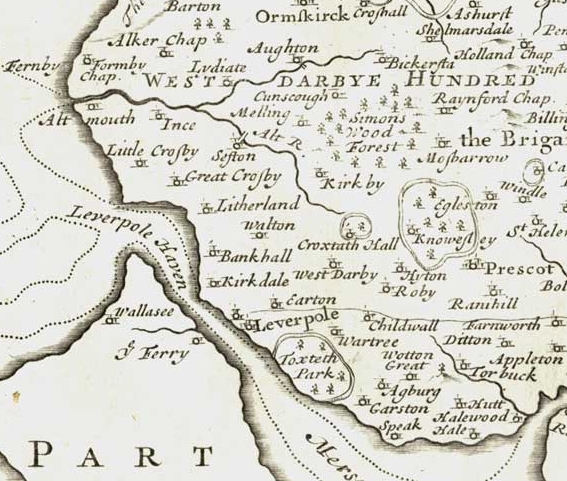
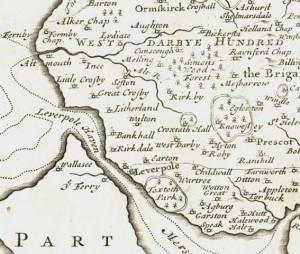
Extract from a map of Lancashire, by Robert Morden, 1695

Liverpool, from Lancashire, by Robert Morden, 1695

This is the first in a series of posts which will hopefully help you research the local history of your area, whether it’s Liverpool or elsewhere. It’s about maps, as my own main site, Historic Liverpool, is based on maps. Part 1 will focus on late 19th and early 20th Century maps.

Beginning Map Research

Maps are an amazing way to research local history. For one, you can start with a recent map, and then by looking at increasingly older editions you can see in reverse the changes which have happened over time. You start with something very familiar, and gradually work your way back. Sometimes, an unbelievable amount has changed in very little time.

But whether you are researching Liverpool, or another city or any rural area of Britain, you’ll need to know what maps have been made of your location, and when they were made. Luckily, in this day and age it’s not hard to find them.

For every local historian, the first port of call must be the Ordnance Survey maps. You can pick up the current version for around £8, or a recent second hand copy off eBay for a fiver. Get a 1:25,000 Explorer map – these show individual buildings but cover enough area (unless you’re really unlucky!) for your needs.

That’s the easy part!

Now you have your anchor, your reference point for all the other maps you’ll be looking at. This serves as the base for your next step, which is known by the professionals as ‘map regression‘. This just means that you collect as many maps as possible, and work your way back through them and noting the changes. I’ll work through an example of this in a future post.

Getting a recent map of your area should be easy enough, but slightly older ones are going to be second hand, so you need to be aware of where to get them.

Second-hand and online maps

eBay

Your first choice for buying paper maps has to be eBay. I’ve bought almost all of my OS maps from this site, each for about the price of a pint of beer. eBay seems to be strongest with the years between 1930 and 2000, particularly 1950 – 1980. OS maps from across this period repeatedly appear for a couple of pounds. Keep an eye on this site so you’re ready when the right map appears, and also you’d do well to keep an eye on what you’ve already bought – more than once I’ve nearly ended up with two maps from the same year!

The list I have for Liverpool includes: 1947, 1952 (last revision 1947-9); 1961 (last revision 1958), 1964, 1978 and 2000. (For an excellent overview and samples of all the OS map series, see http://www.charlesclosesociety.org/osseries).

Older OS maps are a bit harder to find (see below), although occasionally a great find pops up on eBay. Luckily, there are ways you can get a look at OS maps without leaving the comfort of your own home. There are a couple of web sites which let you view old OS maps, and some of these are very nifty mapping sites in their own right.

Old OS Maps

Old OS Maps is a simple name belying an amazing little tool. Unfortunately there’s a big black hole where Liverpool should be. I’d scan in one of my own maps to donate it if only I had a big enough scanner! However, the site’s well worth a look, as it overlays a small modern Google map extract over the centre of the screen, overlaying an OS map from around 1925 to 1945 (depending on location). Have a look if your area lies outside Merseyside.

Leverpoole.co.uk

Leverpoole.co.uk used to be one of the best sites for Liverpool maps. However, most of the maps have been removed now due to ‘unauthorised use‘. This, like the much-missed Toxteth.net, used to be a fantastic resource. It’s a great shame that the owner, Tony Swarbrick, felt this action necessary, and a shame that his stuff was being used without his consent.

However, there is still the 1930s Philips Street Map of Liverpool on there. This is divided into squares, based on the original map gridlines, which are scanned in at a high resolution. There’s also a text index below the map if you know the rough area you’re after but can’t spot it on the map. And then you can click to enlarge the image, which is a great bonus!

Sites of interest on this map are the Overhead railway down the Strand, and the Chester Basin still open in front of the Dock Board Office.

As an aside, Leverpoole.co.uk also has a huge number of photos of Liverpool, which are great for researching listed or historic buildings.

Commercial map sellers

Getting maps off eBay, and viewing maps online are the cheapest ways to get the most common editions, but the following sites will sell you brand new reproductions of old maps. This includes difficult-to-find early editions.

Alan Godfrey Maps

This site publishes a huge list of maps of Liverpool and elsewhere. They’re paperback maps about A3 size, and extremely detailed (though that means they cover a small area). The strange thing about this site is the lack of illustration, and that once you click on links the text turns yellow, making them very difficult to see! However, the maps are an unparalleled resource, and are also sold all the time on eBay.

Cassini

Cassini are a large commercial map company, slightly reminiscent of the National Archives web site, and sells highly polished map products of all types. You can get downloadable or printed maps, and specify the area and period you want. There’s also a boxed set of maps of Liverpool, which comes in useful for the wide-ranging form of map exploring!

David Archer Maps

In many ways David Archer’s is a strange site. Again, a site with little in the way of pictures, and a shop which appears to take orders exclusively over the phone. Still, it’s these quirks for which I have a certain admiration. Take a look at the informal blog “A nice cup of tea and a chat about maps”: it’s quite a rambling but entertaining diversion into other map sites, Christmas cards and exhibitions. It also reveals that David’s a fan of free and open source software, which always gets the thumbs up from me!

There’s a massive list of all the maps they stock, but if you don’t know what you want, or can’t find it, then they encourage you to contact them.

Last Words

This has been a fairly lengthy overview of map sources. There are many more online, but these are the few I keep going back to. In the next part of the series, I’ll have a look at older maps, which are often a lot harder to find.

Of course, if you know of better places to get hold of old maps, share it in the comments!

Ordnance Survey Maps for Local History Research

Ordnance Survey maps are some of the most well-known sources for local history. Here we find out how to get them.

Read more

Slum Saviour to get statue, and Knowledge Quarter revamp

Kitty Wilkinson, pioneer of health reforms and saviour of hundreds of lives during the cholera outbreak of 1842, is to have her statue erected in St Georges’ Hall. She will be the first woman to have such a memorial here.

Currently a shortlist of potential sculptors is being drawn up, and it may be that descendants of Kitty will be involved in the final selection.

Liverpool Knowledge Quarter revamp

The area and roads outside the Metropolitan Cathedral – Liverpool’s Knowledge Quarter – are to get £6m funding for a facelift. The money comes from the Northwest Development Agency, the European Regional Development Fund and the University of Liverpool and Liverpool John Moores University.

See also Liverpool’s Knowledge Quarter gets £6m face lift – BBC Liverpool

Liverpool photo competition, and Local Development Framework

Liverpool Skyline by jimmmedia via Flickr

Liverpool skyline shows the new and the old bidding for space (by jimmedia via Flickr)

The Art in Liverpool blog has news that English Heritage and Liverpool City Council (as part of the Historic Environment of Liverpool Project) are running a competition to contribute to the Shanghai Expo 2010.

The theme of the competition is ‘Your Liverpool’, and you can enter by submitting a photo or about 100 words on the topic.

The 10 shortlisted entries will earn their creators a chance to work with digital designers to produce short pieces on ‘their city of Liverpool’. The pieces will then be shown in the Liverpool pavilion at the Expo later this year. Closing date is 22nd  February.

Future of Liverpool

On the City Council website today is news of a Local Development Framework (LDF) to guide the future development of the city. The plan has been released for a public consultation.

The most relevant of the seven main features for readers of this blog is “Protecting  important historic buildings”. As all Liverpool residents past and present will  know, the city has an amazing array of listed and other historic buildings, particularly in Dale Street, Castle Street and the Lime Street/William Brown Street area. It has also seen a great deal needlessly lost.

So get onto the Council site and have a look at the LDF documents, and have your say at one of the local events!

Liverpool, Musical Maps and Awards

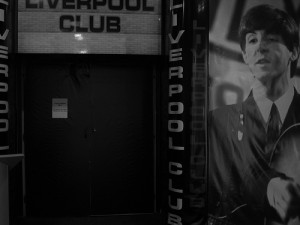
Entrance to the Liverpool Club 2, by iirraa via Flickr

Entrance to the Liverpool Club 2, by iirraa via Flickr

Liverpool is looking to add to its huge box of musical awards (Birthplace of The Beatles, official World Capital of Pop – boasting 56 No1s – and the UK’s Most Musical City) by putting together a bid to become UNESCO City of Music.

The designation is enjoyed by only four cities at present (Bologna, Ghent, Glasgow, Seville), and as far as I can see, adds more of a pop flavour to this mix.

Part of the bid attempt will be to begin “a massive four month mapping exercise of the city’s music”. I hope they’ve seen Liverpool University’s work on music and landscape. (Also check out the associated music downloads available from the Liverpool University web site).

Delicious Tweeting

Don’t forget, you can keep up to date with all the links I post here on my Historic Liverpool Delicious page (no account needed – you can keep up to date with a feed reader).

You should also follow my tweeting about my blog posts and other headlines which might not make it into the main blog as @histliverpool.

Florence Institute restoration, LOR film, and Liverpool art

The Liverpool Echo is reporting that work could begin as early as April on the restoration of the Florence Institute, which has received £3.7 million restoration money from the Heritage Lottery Fund.

£6.6m has already been raised by the Florence Institute Trust, but the new money will allow the construction of  “exhibition and performance space, activities for young people and the elderly, an indoor/outdoor sport area, childcare facilities, workspaces for local business and a Heritage Resource Centre”. An additional £1.7m may be granted by the North West Regional Development Agency.

The Echo also has a brief history of the Florrie, which began life as a boys’ club in 1890.

Overhead Railway video to be screened

Seaforth Sands Railway Station, from Wikmedia Commons

Seaforth Sands Railway Station, from Wikmedia Commons

Motor coach number 3 is the last surviving coach from the legendary Liverpool Overhead Railway. It was donated to National Museums Liverpool when the LOR closed in 1956.

On Friday 29 January from 1 – 4pm FACT will be screening footage of the LOR, showcasing research into the Lumière brothers’ film footage of the railway, and introduced by Dr Richard Koeck. According to the Art in Liverpool  blog:

Dr Koeck will share insights into his research and ongoing production of the film animations that will contextualise and reference the original Lumière archive footage with historical maps of the time, and retrace the precise route of the films.

The LOR and motor coach number 3 will become part of the Port City gallery in the new Museum of Liverpool, due to open in 2011.

Mad About Liverpool?

Of course you are, so head over to the gallery of that name which has opened in Clayton Square. More details on the Art in Liverpool site.

Creative Commons History

Finally, anyone out there know of a good source of Creative Commons historic images?

There’s some good stuff on Flickr Commons, especially from the Library of Congress in the US or the Powerhouse Museum in Sydney, but just wondered if there was  source of Liverpool pictures I could use to illustrate this blog and Historic Liverpool.

If you know of one, let me know in the comments!

How Merseyside’s Historic Landscape Helps During the Snow

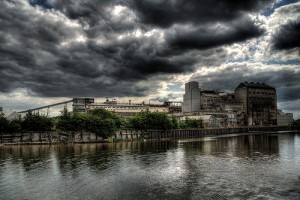
Northwich Salt Factories (part 1), by DaveAdams via Flickr

Northwich Salt Factories (part 1), by DaveAdams via Flickr

The local landscape is playing a major part in snowy events on Merseyside this winter. Salt companies in Cheshire are finding a boom in trade as councils run low on supplies of grit for roads. British Salt Ltd in Middlewich is apprarently running 24/7 and still having trouble keeping up with demand.

Ineos in Runcorn is also helping out, with 12,000 tonnes of salt having already left their depot.

Salt has been an incredibly important industry in Cheshire since at least Roman times, and almost certainly prior to that. Middlewich, Nantwich, Northwich and Winsford are all historic salt mining locations. Middlewich was even called Salinae by the Romans, showing how important the location was for salt (salt was, in turn, of extreme importance during the Roman period. Salt could be used as currency, leading to the modern English word ‘salary’).

PS: Love that amazing HDR photo above, by DaveAdams!

Liverpool 100 years ago

The Echo are starting a new history series, looking at Liverpool 100 years ago. The first, introductory article talks about monarchs, strikes and riots, the Titanic and the Suffragettes.

The main photo in the article shows the Mersey in 1907. Of the major Pier Head/Strand buildings only the Port of Liverpool Building has been built, and it stands head and shoulders above everything else in the viscinity. What a change! This building now feels right in the centre of the commercial district, but at the beginning of the 20th Century this merely meant the docks and the Overhead Railway. The other two Graces, and Tower Building etc, are yet to be contructed, and yet to take their place as the centrepiece in Liverpool’s skyline.

Liscard Hall not to be rebuilt

Finally, news reaches us that Liscard Hall, which burned down in 2008, will not be rebuilt. The Hall was built by Sir John Tobin, one time mayor of Liverpool and successful trader. The grounds of what was once known as Moor Heys House became Central Park in 1891.

Plans now include landscaping of the gardens, and linking them more successfully with the nearby rose garden.

See the Geograph page for National Grid Reference SJ3191 site for a photo of the Hall and Central Park.

Liverpool Culture Director has high hopes for 2010, and history under threat and online

Claire McColgan, Liverpool Council’s culture director, has spoken to the Echo about her hopes for 2010, and how Liverpool should build on the successes of ’08. She mentions the new Central Library, which should open in the next year or so, and the forthcoming Museum of Liverpool, which is very close to completion. It’s great that so many things came out of ’08 (as McColgan points out) but let’s hope Liverpool can see beyond its recent successes and truly stand on its own merits, of which there are plenty.

Frenson’s Buildings at Risk

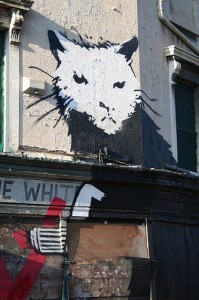
The Whitehouse Pub, complete with Banksy artwork, by Vinnn via Flickr

The Whitehouse Pub, complete with Banksy artwork, by Vinnn via Flickr

UPDATE (5th February): the Whitehouse pub is now up for auction, and is expected to fetch between £70 and £80,000.

UPDATE: Frenson now have two months to sort these buildings out for compulsory purchase happens.

Frenson Ltd, developers, may soon be served with a repairs order for two historic buildings they own in Liverpool, as the Echo reports. Both the Watchmaker’s building, in Seel Street, and the legendary Whitehouse pub, in Berry Street are gradually falling apart, and the city council have promised to compulsorily purchase the buildings, or force the owners to repair them, unless action is taken soon.

The Watchmaker’s building is just part of Liverpool’s great horological history, with makers such as Thomas Russell still greatly admired for their craftsmanship. There is even a watch museum in Prescot, where Russell was based.

Finally, as the snow closes in on Merseyside, don’t let your appetite for museum stuff fade! On the National Museums Liverpool website you can now explore their Winter Online Exhibition, with bits and bobs from all corners of the museum group on view. There are stuffed animals, painted snow scenes and Inuit cultural objects to look through, each with its own description.

I don’t know about you, but my favourite’s got to be the little Inuit polar bear carvings!

http://www.liverpoolecho.co.uk/liverpool-news/local-news/2010/02/04/landmark-liverpool-hotel-with-banksy-s-famous-rat-is-going-up-for-auction-100252-25758215/

Happy New Year!

Hope you all had a great holiday and are raring to go! 😉

2009 was a great year, and this blog really got going – thanks to all my readers, over 1000 of you in November! I hope to make 2010 even better, and try to develop the blog in some way to make it more interesting. I’ll be writing more posts on Liverpool’s history and landscape, as well as commenting on the news like I’ve been doing so far. Remember, though, that all the interesting headlines are shown on the right. If you’re an avid Twitterer, then you can also follow every update at @histliverpool. I’ll be posting news items, links to new blog posts, and any progress with Historic Liverpool (I promise I haven’t forgotten that in all the blog excitement!).

It’s World Museum Liverpool’s 250th anniversary this year, so even more reason to celebrate – why not visit it again to stretch your leg and brain muscles after Christmas?

Also, the Stephen Shakeshaft exhibition ‘Liverpool People‘ is on until 24th January. I visited over Christmas and really enjoyed it! What some Scousers had to endure over the twentieth century is unbelievable, and to keep a sensa yuma throughout just about sums up Merseyside’s attitude to life!

If there’s anything you’d like to see on this blog, do let me know, but otherwise just keep reading and commenting!

Cheers!