Bootle village in 1851, from the Ordnance Survey 1st Edition
I’ve put the finishing touches to the History of Bootle page today (minus a couple of tweaks here and there). I’m planning on concentrating more on Historic Liverpool over the coming weeks, after being more involved in other projects over the past weeks.
So, if you know anything about Bootle, or there are other pages you want to see on the Historic Liverpool site, drop me a line or fill in the comments form!
Historic Liverpool is all about the historic landscape of Liverpool, rather than the history. So while there are thousands of merry men and women who’ve appeared in the annals of the city over the years, I’ll be concentrating on the built environment – how the city has changed over the years. So I’ll be most interested in comments about buildings – farms, offices, libraries, churches – and landscape features – lakes, ponds, forests, streams, dams – and things like roads and railways. If, of course, you know of great people who’ve shaped the city and its suburbs, and who deserve a place on the site, please do mention them in the comments – I won’t delete anything unless it’s spam!
Bootle’s one of the areas that’s changed the most – from a tiny village (albeit with its own waterworks) through being a seaside resort(!) to an industrial landscape and the modern area of Liverpool it is today.
I’ll be moving on to Childwall next, so if there’s something you’ve been dying to tell about that part of south Liverpool drop me an email or comment. Or if there’s some other part of Liverpool’s history you’d be more interested in finding out about, give me a shout and I’ll do that instead.
I look forward to hearing from you! (Don’t all shout at once…)
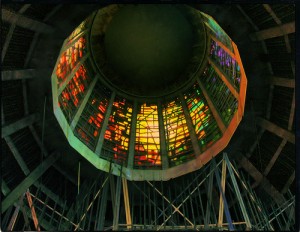
Liverpool Metropolitan RC Cathedral, by Jonathan Gill via Flickr
A new book is released this month by Stephen Bayley, and published by RIBA.
Liverpool: Shaping the City is a large and colourful exploration of the city’s built history. It includes development, old and new and brings in photographs from the early 20th Century when some of Merseyside’s most iconic buildings were being constructed.
We learn in the Foreword by RIBA’s president Ruth Reed that Liverpool can lay claim to three world firsts in architecture: the first building to use skyscraper technology (Oriel Chambers in Water Street), the first wet dock (no prizes for guessing) and the first hydraulic cargo-handling system.
Perhaps I’ll come back to a full review of this book once I’ve read it (it only arrived this morning!), but suffice to say it looks to include good coverage of how Liverpool has developed as a city, and how it does and will continue to change as the years progress.
Meanwhile, you can read a column in the Times by Stephen Bayley, How Liverpool returned from the dead which introduces some ideas from the book. His main point is that you can ‘design your way out of a depression’ by building cities which bring joy to people. From a personal point of view, I whole-heartedly agree (though my cynicism would reword it as ‘design yourself towards the end of a depression), which is why I – and others – get so animated when an ugly construction is plonked down in a beloved vista.
My favourite quote from the article, and one which almost single-handedly justifies this blog and my interests in Liverpool’s buildings, is “We make our environments and then our environments make us”. He suggests putting it on a T-shirt, and I just might.
Welcome back to the Liverpool Landscapes blog! I do hope you came checking every day while I was away ;-), but even if not, you’ll be glad to know I’m rested, relaxed and raring to go to bring you the most interesting bits of news concerning the history of Liverpool. The theme of this post seems to be milestones, in a way, so let’s start with politics…
The general election and history
The first occasion on the horizon is of course the General Election. As a civil servant, I should probably be careful what I say in the run up to May 6th, but it’s worth pointing out that the Museums Journal this month contains a short analysis of what the main parties intend to do should you vote them into power next month. (You’ll need to register to view the article, or pick up a copy of MJ in the local library).
All the parties seem to agree on free admissions to museums, a move away from targets, and on increasing access to arts and cultural institutions. However, Louise de Winter of the National Campaign for the Arts notes that Labour’s reliance on free admission to help with increased access is not enough.
The Conservatives emphasis on helping people to help themselves (“Big Society, Small Government”) may extend to the cultural sector, with an ‘arm’s length principle‘ being applied to supporting museums.
The Liberal Democrats also want to enable museums to be more independent and enterprising, and want to generate more arts and heritage money from the National Lottery through tax changes.
At the time of the Journal’s press, the Labour manifesto had not been released, but it noted that the party wanted to ensure all Britain benefits from the digital revolution, and to build on earlier schemes such as Find Your Talent.
English Heritage publish heritage protection paper
Even though the Heritage Protection Bill did not make it into the Queen’s Speech last year, work has continued on reforming the way the historic environment is cared for.
All you professional archaeologists out there will know about PPG15 and PPG16, the two documents which make rescue archaeology (and so the vast majority of professional archaeology occurring in this country) possible. These documents are both almost 20 years old, and have been replaced by Planning Policy Statement (PPS) 5.
The long term aims with heritage protection reform (HPR) are to replace the current system of listed buildings, scheduled monuments and other designations with a single, hierarchical system. This would make it easier to protect historic sites and buildings, as well as make it simpler for owners of such assets to find the information they need to effectively protect them.
The new document also covers such topics as approaches to planning, climate change issues, and the monitoring of the historic environment. It’s available to download from the Department for Communities and Local Government Planning for the Historic Environment page.
Well, those are probably the big stories of the day, but there are a few more tidbits to cover.
It’s International World Heritage Day tomorrow (18th April)! Now, I’m assuming that anyone reading this post is somehow interested in a certain World Heritage Site, and now’s your chance to raise awareness of where it is, and the work it takes to preserve and look after it.The Global Development Research Center (sic) has a few suggestions on what people can do to celebrate and commemorate.
Liverpool City Council have organised five tours of parts of the city which fit in with this year’s theme, which is the Heritage of Agriculture. Now, you may argue that Liverpool’s WHS has little to do with agriculture, but as the foremost port of the empire, merchants in Liverpool oversaw a huge proportion of the transport of the world’s agricultural produce. For details of the tours, download the leaflet from the Liverpool World Heritage web site. Places are limited, so get in early!
Speaking of mercantile heritage, the Old Dock is finally to be opened to the public on 4th May. As the BBC report, the remains of the dock wall were carefully preserved during the construction of Liverpool One, and can be seen through a window placed in the floor at the bottom of the steps from the Liverpool Wheel where the Liverpool Wheel used to stand [cheers for the correction, Adrian!].
From next month, there will be a “visitors’ facility” to allow you to view objects found during archaeological excavations there, a computer reconstruction fly-through, and the east section of the dock which has a tunnel suspected of linking to Liverpool Castle. More details are available on the Maritime Museum Liverpool web site.
And finally-finally, architects Baca have another masterplan to ruffle the feathers of the Liverpool Preservation Trust et al. This time the south docks are in the picture, and Baca want to “bring an interesting new approach to waterspace design that will unlock the potential of these wonderful docks and the World Heritage Site”.
As you know, I for one consider that the World Heritage Site needs its potential unlocking. It’s so… tied up there in those creaky old buildings.
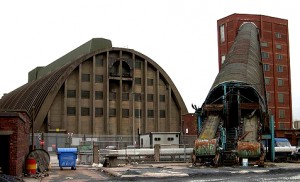
Sugar Silo & Conveyor, Huskisson Dock, Liverpool, by David Barrie via Flickr
Hello! It looks like my hopes for getting the second historic maps article to you this week have come to nought. It’s amazing how much time arranging a wedding soaks up!
So, before I head off on honeymoon, as I can’t bring you the usual detail of stories, I’ll resort to the bulleted list:
The BBC have shown archive footage of the 1960 fire in Henderson’s department store. A link to the Inside Out programme which showed the footage is available from the BBC Liverpool article on the fire.
One of the earliest railway tunnels – Bourne tunnel in Rainhill – has been listed at Grade II. Buildings are listed if they are of nationally significant architectural value.
Well, I hope that can tide you over until mid-April, when I return. I promise much more exciting articles in the weeks and months to come, on all aspects of the history of the city of Liverpool. Until then: au revoir.
It’s been a little while since I posted. Just because the previous post was the 100th (you have been counting, right?) doesn’t mean I’m quite finished with Liverpool Landscapes. I’m currently drafting the second Liverpool Maps post, and also preparing for a rather important personal event coming in the next few weeks. So I hope to get that post to you very soon, and then there’ll be another short gap before you hear from me again (say, late April).
But before I go, here’s a couple of snippets for you to enjoy.
Capital of Culture a success
Impacts 08, as regular readers will know, is a study being carried out by the University of Liverpool and Liverpool John Moores University to study Liverpool in the wake of 2008’s Capital of Culture.
They’ve already published a couple of reports, but the latest one gives details about the overall experience of the CoC title. A few choice stats (taken from the Guardian report):
34% increase in tourists (to 9.7m);
85% of Liverpool residents said it was a better place to live;
97% of visitors said they felt welcome.
This is a positive reaction, as there were many detractors in the years leading up the event. I felt, as the Guardian reports, that there were many who worried what would actually happen. There were forever the cynics who’d already decided we’d cock it up.
I remember one Pythonesque encounter on Radio Merseyside:
“One revolutionary pop band does not make a Capital of Culture.”
“What about the football teams?”
“Well, yeah, but two world class football teams and one revolutionary pop band do not make a capital of culture.”
“And the architecture?”
“OK. 2,500 listed buildings, two world class football teams, one revolutionary pop band…”
“And two of the greatest cathedrals-”
“…and two of the greatest cathedrals in the world do not make…”
And so it went on. I paraphrase, of course, but that was the gist of the thing.
I’ve pointed out Pete Carr’s photography before, but that’s no reason not to mention another. Here’s a great one of the town hall. Pete admits it’s hard to get a shot of the hall without Martin’s Bank in the background, but the bank’s such a great building that it serves as a classy backdrop to this tight shot.
Lewis’s has only recently announced its closure, but already plans sneaking out about what will come after it. Still no word on whether the shop itself will be ‘resurgent’ in the new development, but plenty of comment, so I’ll leave to to pop over to those sites for a read.
Plans for a ‘Central Village‘ have been on the cards for a few years already.
Robin Brown on the Liverpool Culture Blog is right to worry about what will go in the new ‘Central Village Liverpool’ . What with Liverpool One and the new developments from Paradise Street up to Renshaw Street, Liverpool is at risk from each area pulling customers away the others. If this development is to work, it will have to have its own distinctive character.
However optimistic we are, Liverpool has only got so much money to spend, especially at the moment. As this is near Lime Street, there is a good chance Central Village will attract visitors from outside the city, but if it apes the rest of the new developments, Liverpool will lose its character, and it’s often bold independent shopping soul.
The covenant dictated that no building be constructed within 40 feet of the River Mersey, and any building here would not be more than 40 feet tall. This was to maintain the lines of sight between the Port of Liverpool building and offices at the Albert Dock. This document was signed in 1963 when the Mersey Docks and Harbour Board sold the land the museum now stands on to Liverpool Corporation.
It seems that NML’s David Fleming chose to pay the money upfront before Dowling were tempted into suing for a predicted £70,000.
Visitor numbers up for Liverpool museums
Better publicity for NML comes in the form of visitor numbers to all the museums on Merseyside, which rose to 2.2m in 2009 from just over 2m in 2007.
Of course, 2008 was going to take some beating, so it’s good to know that the trend from the last ‘normal’ year is a positive one. You can only imagine that with the new museum next year, visitor numbers will increase again.
More details and figures for the individual museums are available on the Art in Liverpool blog.
Lewis’s lives on – for a little while longer
Now that Lewis’s has announced it’s closing down, memories turn to its ‘golden years’ in the last century.
A new exhibition by photographer Stephen King is being shown at the Conservation Centre, focussing on the fabled ‘Fifth Floor’. This is where the old cafe was, along with the biggest hair salon in the world. It’s also home to an amazing range of (now) retro design – bright colours in the post-WWII era, yellow walls, orange ceilings and blue chairs, and egg-shaped hair-dryers and 1950s lino floors.
Photographs also include portraits of Lewis’s employees past and present, to breathe some life into the eerie space.
The exhibition runs from 26th February until 30th August. You can follow the exhibition on the Lewis’s Fifth Floor blog.
Abbey Road studios finally listed
You may be aware of the current saga of Abbey Road studios in London; its future uncertain while rumours flew that it would be sold off by owners EMI.
Well, the Culture Minister Margaret Hodge has announced that she would be taking on board English Heritage’s recommendations, and would be listing the Georgian townhouse which contains the studios.
English Heritage first proposed that the building be listed in 2003, but had been ignored until this great publicity opportunity fell at the minister’s feet. Even EH had originally been reluctant to recommend listing, but current listing criteria include ‘historic’ as well as ‘architectural’ significance. And Abbey Road certainly has that.
Over the past few weeks I’ve come across a handful of very interesting looking sites for those of you with a local history interest. The best thing about them is that they’re after your input, so pop along and see what you can contribute!
Building History is a specialised wiki site, much like the (in)famous Wikipedia and the Liverpool Wiki. It encourages users to submit information about any road or building to its database, even the one you live in! Almost 200 roads and nearly 300 buildings have been added, and the site’s only been online since October 2009.
All you need is an email address, and you can get going. The Warwick page is the most complete, so use that as a template. Liverpool is there, waiting for someone to add something, though note that it’s placed in Lancashire!
For those privacy-concerned individuals (like me), it’s good to know they only allow publicly-available data to be added (census data, for example).
Finally, we have the Open Plaques project. This, in its own words, is “a service that aims to find and provide data about all the commemorative ‘plaques’ (often blue and round) that can be found across the UK and worldwide”.
You can browse their database via peoples’ names, places, or organisation, and the site wants all the plaques photographed, tagged with their geographical location, and have their colour identified. There’s a neat little graph on the home page letting you know how they’re getting on.
The data comes from a variety of sources (including English Heritage’s blue plaques site and Freedom of Information requests) which have been cleaned up for presentation on the site.
You can help them by getting in touch, or taking a photo of one and uploading it to Flickr. If you tag the photo correctly (as explained on the site) it will appear next to the relevant entry. Brilliant! All the data is free for you to reuse, and the maps are created using OpenStreetMap. You can follow the project via Twitter: @openplaques, or on their .
Three listed buildings in Liverpool are amongst over 150 to receive money from English Heritage and the Heritage Lottery Fund’s Repair Grants for Places of Worship scheme.
The Church of All Hallows (£103,000), St Michael in the Hamlet (£199,000), plus the Princes Road Synagogue (£71,000) were all beneficiaries of the latest round of grants, which totalled £15.7 million this year. The money will be spent on repairs and restoration of the buildings, as well as anti-vandal measures where necessary.
Speaking of the museum, a new fused glass map which will take pride of place in the galleries when MoL opens next year is to go on display at the Daily Post’s offices in the city centre. There’s a blog on the Daily Post web site to keep you up to date with progress with the map.
Now if only they’d do an electronic version I could stick on my site!
Work begins on the International Garden Festival site.
After 26 years, work is finally to start on the site of the 1984 Garden Festival. The Oriental gardens will be restored, lakes dredged and undergrowth cleared. Plenty of people in the Liverpool Echo article are ‘delighted’ at the ‘milestone’. 600 homes were built straight after the Festival, and Pleasure Island gave many a young schoolkid a fun Bank Holiday in the 1990s, but developers Langtree hope that this latest phase of building will create a worthy leisure facility for Merseyside and kick-start the collapsed apartment project from 2008.